How to Grow Rhubarb: Plant Once, Crop for Decades
How to grow rhubarb from a crown: where to plant it, why you pick nothing in year one, how to force it for early stems, and when to divide the crown.
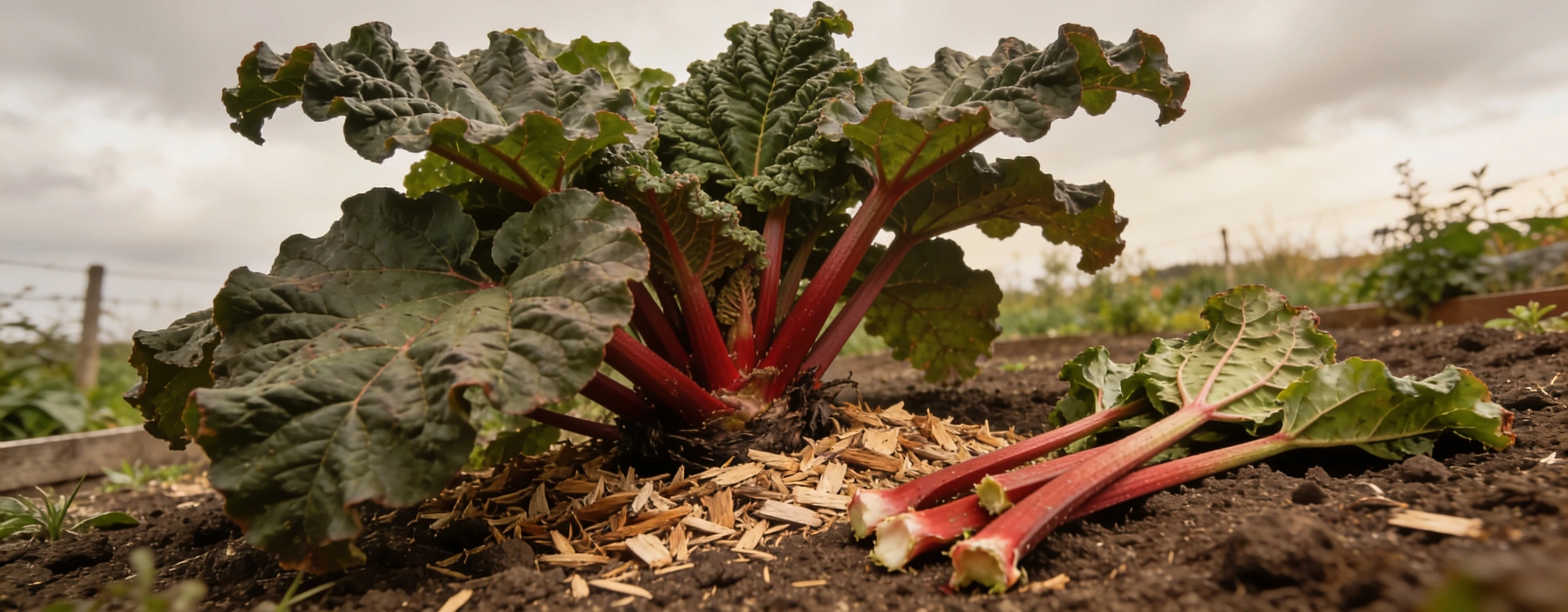
Rhubarb is the best value plant I grow. One crown, planted once, cropping for twenty years or more, and in return it asks for a barrow of compost a year and almost nothing else. The only real skill is patience in the first year, which is exactly where most people go wrong, myself included.
The short answer
Plant a dormant crown between November and March, buds just at the surface, 90 cm apart, in ground you have loaded with compost. Pick nothing in year one, a little in year two, then crop properly from year three. Stop picking around early July so the plant can build reserves. Mulch every spring, cut out flower stems on sight, and divide every five to seven years. Leaves are toxic, stems are not.
Where to plant it, and why it matters more than usual#
Rhubarb stays where you put it for two decades, so this is worth ten minutes of thought.
Full sun gives the heaviest crop, but light shade is genuinely fine and often produces slightly more tender stems. What it will not tolerate is waterlogging in winter, which rots the crown.
It is also a large plant. A mature crown throws leaves a metre across, which surprises people who planted three of them 40 cm apart. Ninety centimetres between crowns, and do not put it where it will shade something you care about.
Key points
- Sun or light shade, and not a spot that sits wet in winter.
- Ninety centimetres between crowns. A mature plant is far bigger than the crown you are planting.
- Improve the ground properly first, because you will not get another chance to dig it over.
- Put it somewhere you can reach easily. You will be out there in April, in the rain, in slippers.
- Not directly under trees. Rhubarb is hungry and will lose that competition.
Planting a crown, which is a ten minute job#
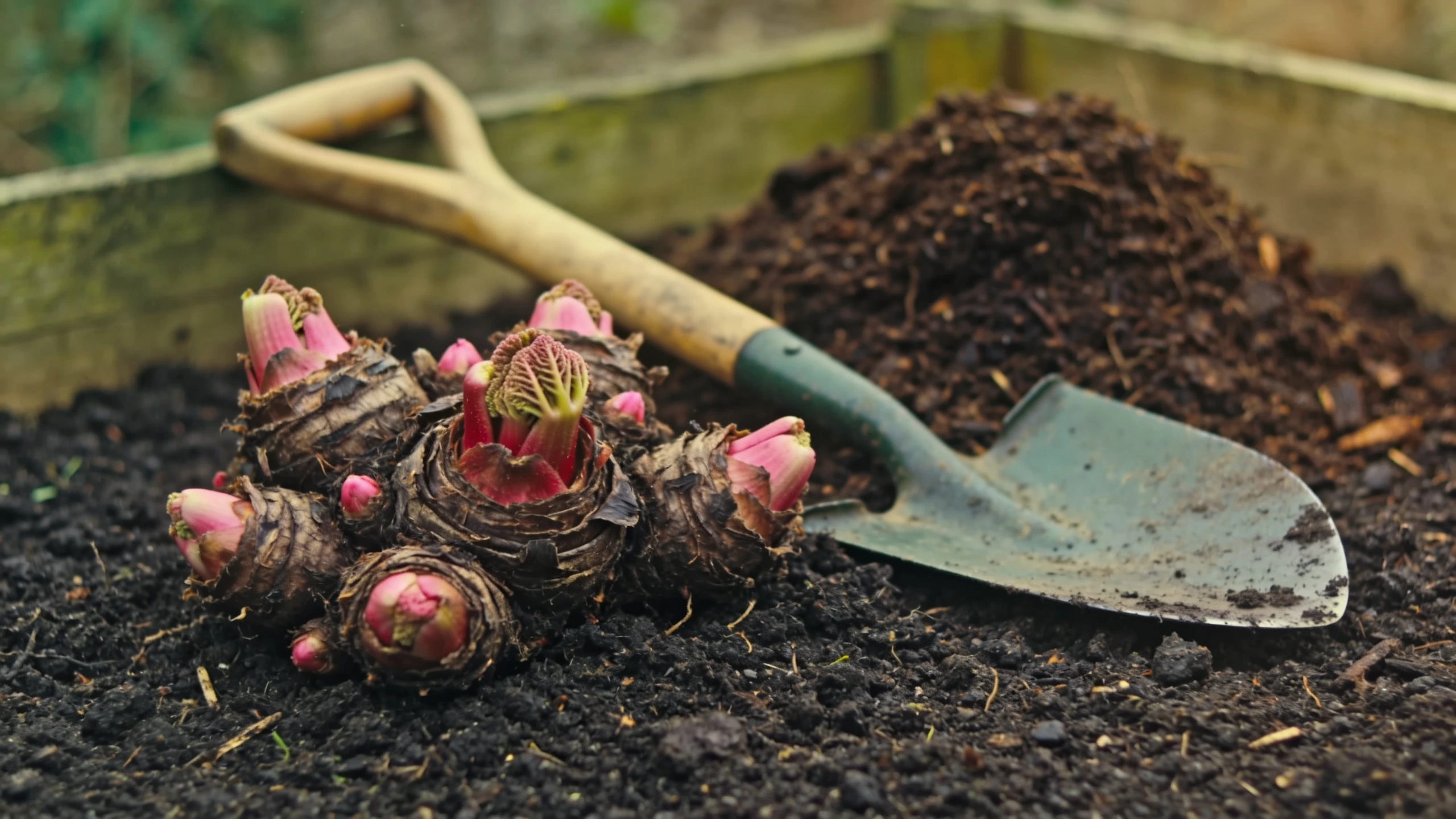
Buy a dormant crown in winter. It looks like a dead lump with a few pink buds on it, and that is correct.
Dig a hole wider than it needs to be, fork the bottom, and mix a generous amount of compost or well rotted manure into the soil you took out. Rhubarb is one of the few things where you genuinely cannot overdo the organic matter.
Set the crown so the buds are level with the surface or barely under it, no more than 2 to 3 cm. Buried too deep, the buds rot; sitting too high, the crown dries out. Backfill, firm with your heel, water in.
Then mulch around it with compost, keeping it clear of the buds themselves.
The first year, and the mistake everyone makes#
Pick nothing.
I know how that reads when a plant produces perfectly good looking stems in its first spring. But the crown spends its first year building the root system that supplies the next twenty, and every stem you take is leaf area it needed for that.
The schedule that works:
- Year one
- Nothing. Let every leaf grow and die back naturally. Mulch in autumn. This is the year that decides how good the plant becomes.
- Year two
- A light crop. Three or four stems, once, and stop. Leave at least two thirds of the leaves on the plant.
- Year three onwards
- Crop properly, from the first stems in spring until early July, always leaving a few leaves on each crown.
If you cannot wait, buy a two year old crown or beg a division from someone who is splitting theirs, which is how most rhubarb travels anyway.
Picking it properly#
Pull rather than cut. Hold the stem low down, twist slightly and pull sideways and it comes away cleanly at the base. A cut stem leaves a stub that rots back into the crown.
Never strip a plant. Take about a third of the stems at a time and leave the rest working.
Stop around the end of June or early July, or roughly eight weeks after you started. This is not about the stems becoming dangerous. It is that the plant needs the second half of summer with a full head of leaves to build reserves for next spring. Later stems are also tougher and more stringy, so you are not missing much.
And cut the leaves off as you go. They are toxic and they are also a lot of bulk to carry into the kitchen.
Forcing, for stems five weeks early#
This is the one bit of showmanship rhubarb allows, and it is genuinely worth doing.
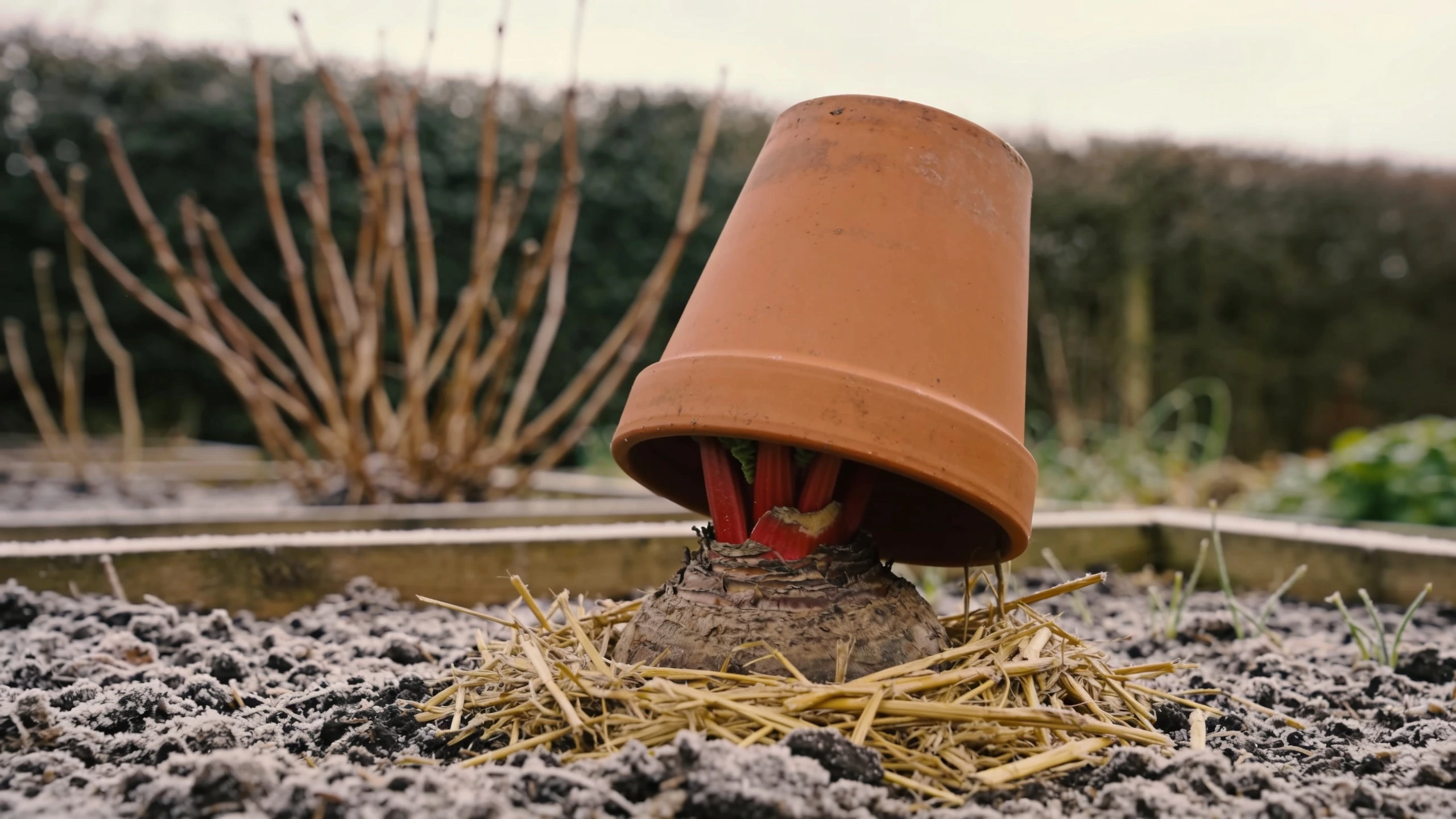
In midwinter, while the crown is dormant, cover it with something that excludes all light. Traditionally a tall terracotta forcer, but an upturned bin, a bucket or a stack of tyres does exactly the same job.
The plant pushes up pale pink stems reaching for light that is not there. They are tender, mild and ready three to five weeks before the uncovered crowns, which in a hungry part of the year feels like a considerable trick.
The cost is real though. Forcing takes a lot out of a crown, so force the same plant no more than once every two or three years, and never force a plant under three years old. If you want forced rhubarb every year, grow three crowns and rotate which one you cover.
Feeding, mulching and the annual routine#
Rhubarb is hungry, and it is one of the few plants where being generous clearly pays.
The whole annual routine is short. In autumn or late winter, after the leaves have collapsed, clear the dead foliage and put a thick mulch of compost or well rotted manure around the crown, keeping it off the buds themselves. That is essentially it.
If a flower spike appears, and on older or stressed plants it will, cut it out at the base as soon as you see it. Flowering and setting seed takes a large amount of energy that would otherwise go into stems.
The RHS pages on soil, composts and mulches cover what to use if you are choosing between compost and manure, and either works well here.
Dividing, every five to seven years#
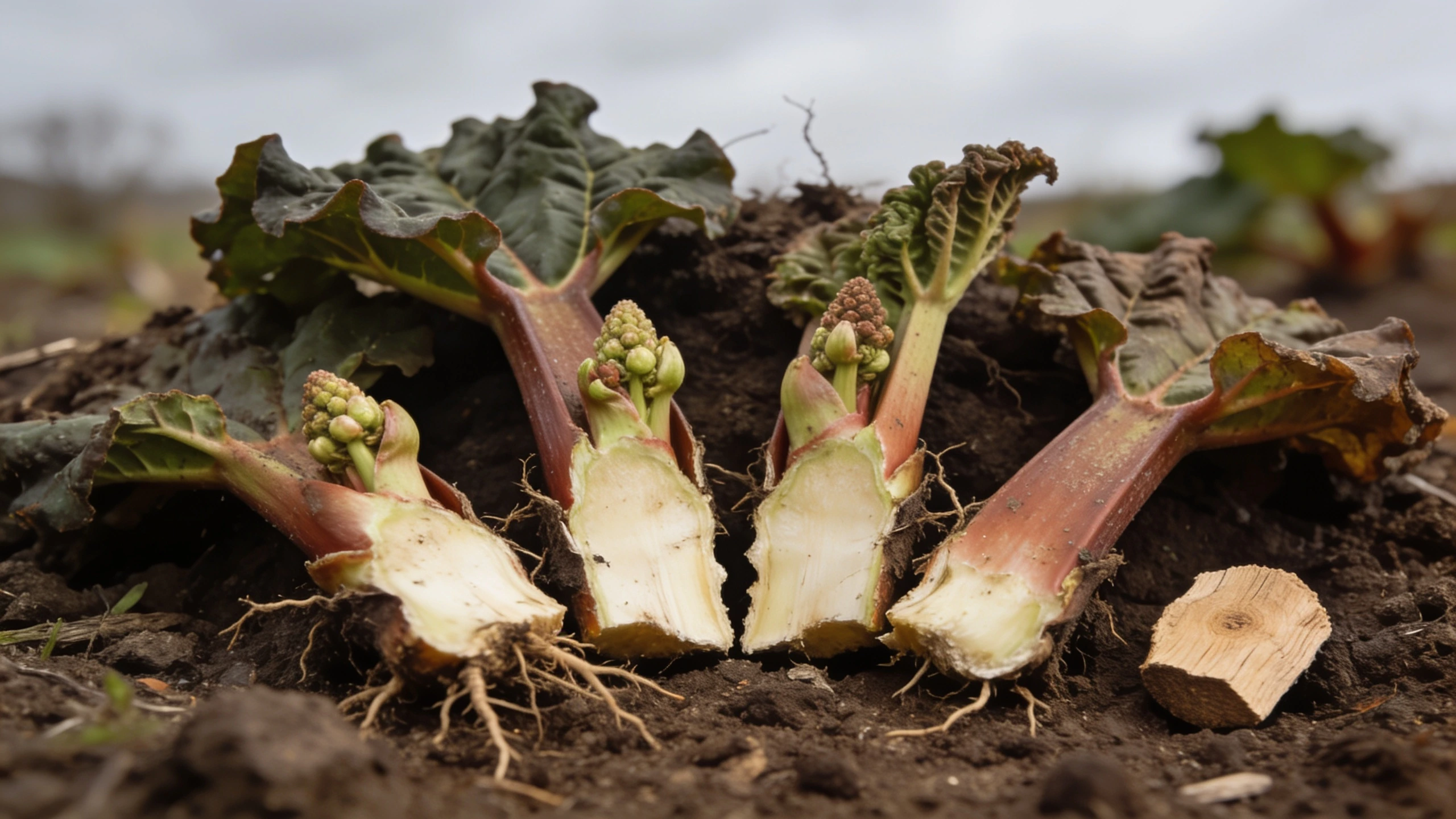
Eventually the crown becomes congested, the centre goes woody and the stems get thinner. That is the signal.
In winter, while dormant, lift the whole crown with a fork and split it with a spade into pieces, each with at least one good bud and a decent chunk of root. Discard the woody middle. Replant the outer pieces at the right depth, spaced properly, in ground you have re-enriched.
One tired plant becomes three or four good ones, which is how most gardeners end up with more rhubarb than they need and how their neighbours get theirs.
What can go wrong#
Thin, weak stems. Almost always congestion, over-picking, hunger or flowering. Work through those four in that order.
Crown rot, showing as soft brown collapse at the base. Usually planted too deep or in ground that sits wet. Rhubarb will not forgive a waterlogged winter.
Nothing coming up in spring on a new crown. Sometimes it is simply late, and rhubarb can be three or four weeks behind what you expect. Do not dig it up to check, which I have done, and which does not help.
What it costs#
- One dormant crown
- $8 to $20 in winter. This is the entire cost of twenty years of rhubarb.
- A division from a friend
- Free, and usually better, because you can see the parent plant is healthy.
- Compost or manure, annually
- $10 to $25 a year, or nothing if you make your own.
- Terracotta forcer
- $60 to $180, and entirely optional. An upturned bin does the same job.
- 50 litre container, for a pot grown plant
- $30 to $70, plus more watering and a division every three years.
Where this needs adjusting#
In a hot climate rhubarb struggles, because it needs a genuine cold dormancy to crop well. Where winters are mild it can be grown as a shorter lived plant, replaced more often, and it will never be as productive.
In heavy clay, plant on a slight mound or in a raised bed to keep the crown out of winter wet. That single adjustment fixes most rhubarb failures on clay.
And in deep shade it will survive without producing much. Rhubarb tolerates light shade and does not tolerate darkness.
Where the guidance here comes from#
The planting depth, the first year rule and the forcing rotation are conventional and I have followed them in my own garden, including learning the first year rule by ignoring it. For crop timing, feeding and division intervals I check against the RHS advice on growing your own, and Garden Organic is the better source on feeding a hungry perennial from compost rather than fertiliser.
The short version#
Buy a dormant crown in winter. Compost heavily, plant with the buds at the surface, 90 cm apart. Pick nothing in year one, a little in year two, properly from year three. Stop in early July. Mulch every year, cut out flowers, divide every five to seven years. Never eat the leaves.
Related reading#
- How to start a vegetable garden: where a permanent crop like this fits in a plan.
- Composting for beginners: the annual mulch this plant runs on.
- Garden planner: why perennial crops sit outside the rotation.
- Victory garden ideas: the wartime logic of a plant that crops for decades with no annual sowing.
Frequently asked questions
How do you plant rhubarb?
Plant a dormant crown between November and March, in a sunny or lightly shaded spot in ground you have improved with a generous amount of compost. Set the crown so the growing buds sit just at or barely below the surface, about 2 to 3 cm, and firm it in. Space crowns 90 cm apart, because a mature plant is much bigger than the thing you are planting.
Why should I not pick rhubarb in the first year?
Because the crown is building the root system that will feed it for the next twenty years, and every stem you remove is leaf area it needs to do that. Pick nothing in the first year, take a light crop in the second, and from the third year on you can crop it properly. It is the single most common mistake and it costs you years of vigour.
When should you stop picking rhubarb?
Around the end of June or early July in a temperate climate, or roughly eight weeks after you started. After that the plant needs its leaves to build reserves for next spring. Stopping is about the plant rather than about the stems being unsafe, though later stems do get tougher and stringier.
How do you force rhubarb?
Cover a dormant crown in midwinter with something that excludes all light, traditionally a tall terracotta forcer but a bin or a bucket works, and the plant produces pale, tender, early stems reaching for light. You get a crop three to five weeks earlier. Force the same crown no more than once every two or three years, because it takes a great deal out of it.
Are rhubarb leaves poisonous?
Yes, the leaves contain oxalic acid at levels high enough to make you ill and should never be eaten. The stems are perfectly safe and that is what you grow it for. Cut the leaves off after harvesting and compost them, which is fine to do: composting breaks the oxalic acid down and the finished compost is not harmful.
Why is my rhubarb thin and weak?
Usually one of four things. It is congested and needs dividing, which is due about every five to seven years. It is being over-picked, especially if it was cropped in its first year. It is short of feed, since rhubarb is genuinely hungry and wants compost or manure annually. Or it has flowered, which diverts a lot of energy: cut the flower stem out as soon as you see it.
Can you grow rhubarb in a pot?
You can, and it is a compromise. Use the biggest container you can manage, at least 50 litres, because a mature crown is a big hungry plant with a substantial root system. Expect thinner stems, more watering and to need to divide and repot every three years or so. In the ground it is close to no work; in a pot it is a job.
Topics in this article
About the author
Jeff has gardened professionally for over twenty years, mostly on heavy clay, and writes everything here from beds he still works himself. More from Jeff Tanun →
Keep reading
How to Grow Irises
How to grow irises: bearded irises want their rhizomes baking on the surface, not buried. Which type suits your soil, when to divide, and why yours stopped flowering.
Updated
Flower Gardening
Flower gardening made simple: pick plants that suit your light, plant them closer than feels right, and get colour from spring to frost. With costs.
Updated
Native Plant Garden
A native plant garden without the purism. Why native means local rather than national, how to find your own list, and where non-natives still earn a place.
Updated