Japanese Garden Ideas That Work in a Small Space
Japanese garden ideas built on the actual principles: asymmetry, borrowed scenery and restraint. What to plant, what to leave out, and a plan for a small corner.
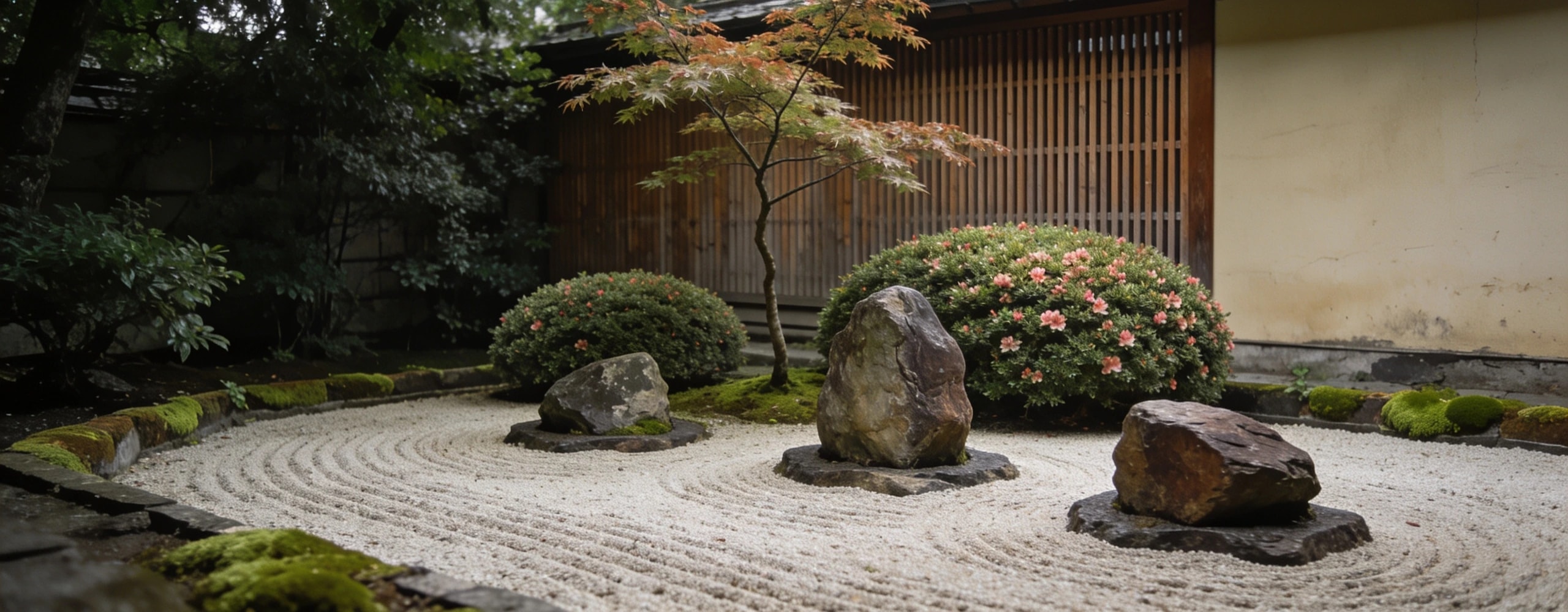
Japanese garden ideas travel badly, because what gets copied is usually the ornaments rather than the principles. I got interested after realising that the small courtyard gardens I liked most in photographs all had fewer plants than my own border, not more. What follows is what actually creates the effect, and how much of it fits into an ordinary back garden corner.
The short answer
Design for one view, usually from a window or a seat. Use three or four plant species repeatedly rather than twenty once each, mostly green with one moment of colour. Set an odd number of rocks with a third of each buried so they look native. Keep everything asymmetric. Use planting to frame something beyond your boundary and screen the rest. One well placed object, not five.
The principles that do the work#
Almost everything that makes a garden read as Japanese comes from four ideas, none of which costs anything.
- Asymmetry
- Nothing is paired or centred. Odd numbers, offset placement, no matching anything. This single rule does more than any plant choice.
- Shakkei, borrowed scenery
- Frame something outside your garden so it reads as part of it. Screen everything you do not want. Makes a small space feel much larger.
- Restraint
- A short plant list repeated. Mostly green, mostly foliage. Colour used once, as an event rather than a scheme.
- Composed from one viewpoint
- Designed to be seen from a specific place, often sitting and often from indoors. Pick that place first.
That last one is the most useful correction to how most of us garden. A Japanese garden is not arranged to look good from everywhere. It is arranged to look right from the chair.
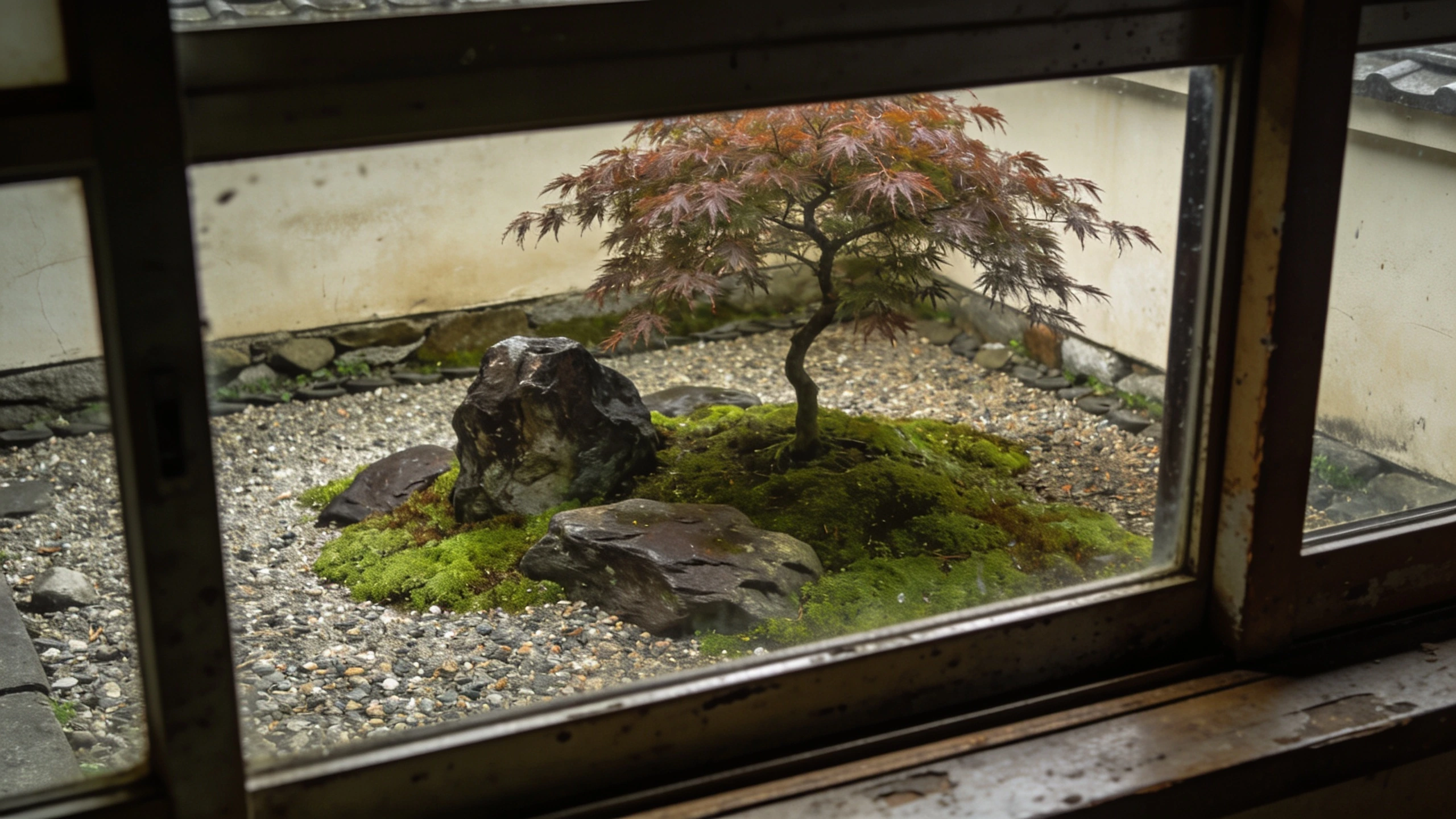
Rocks, and the part people get wrong#
Rock is the skeleton of the style, and there is a right and a wrong way to place it.
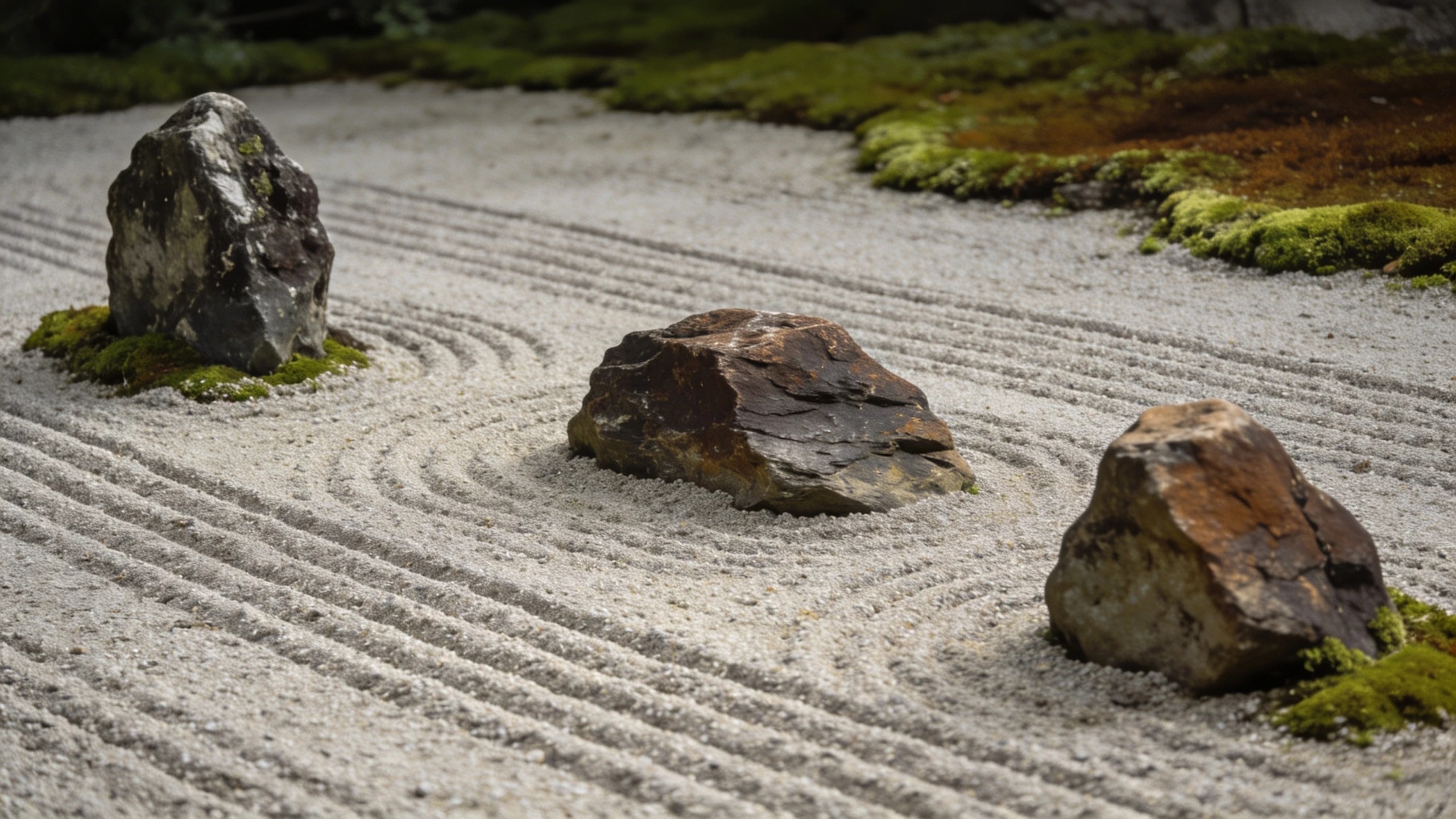
Bury roughly a third of each stone. A rock sitting on the surface looks delivered; a rock partly buried looks like the garden was built around something that was already there. This one adjustment transforms the effect and costs nothing but digging.
Group in odd numbers, with a clear hierarchy: one dominant stone, one or two subordinate, never the same size and never evenly spaced. If you can see a rhythm in the spacing, redo it.
And choose one type of stone for the whole garden. Mixed rock types read as a collection, which is the opposite of what you want.
A short plant list, used repeatedly#
This is where restraint pays. The convincing gardens use very few species.
- Japanese maple
- The one indispensable plant. Slow, elegant, brilliant in autumn. Wants shelter from wind and afternoon shade in a hot spot.
- Pine, kept small
- Structure and year-round green. A dwarf mountain pine gives the shape without needing decades of training.
- Azalea, clipped
- Clipped into low rounded mounds it reads as landform rather than as a flowering shrub. That is the trick.
- Hakonechloa
- Japanese forest grass. Falls in soft layers, glows in shade, needs nothing. The best value plant here.
- Moss
- Only if you have damp shade. It is the most authentic ground layer and it cannot be faked in a dry sunny spot.
- Fern and hosta
- The shade filler. Texture rather than colour, which is the whole idea.
- Bamboo, clumping only
- Running bamboo will take your garden and your neighbour's. Clumping species only, or grow it in a container.
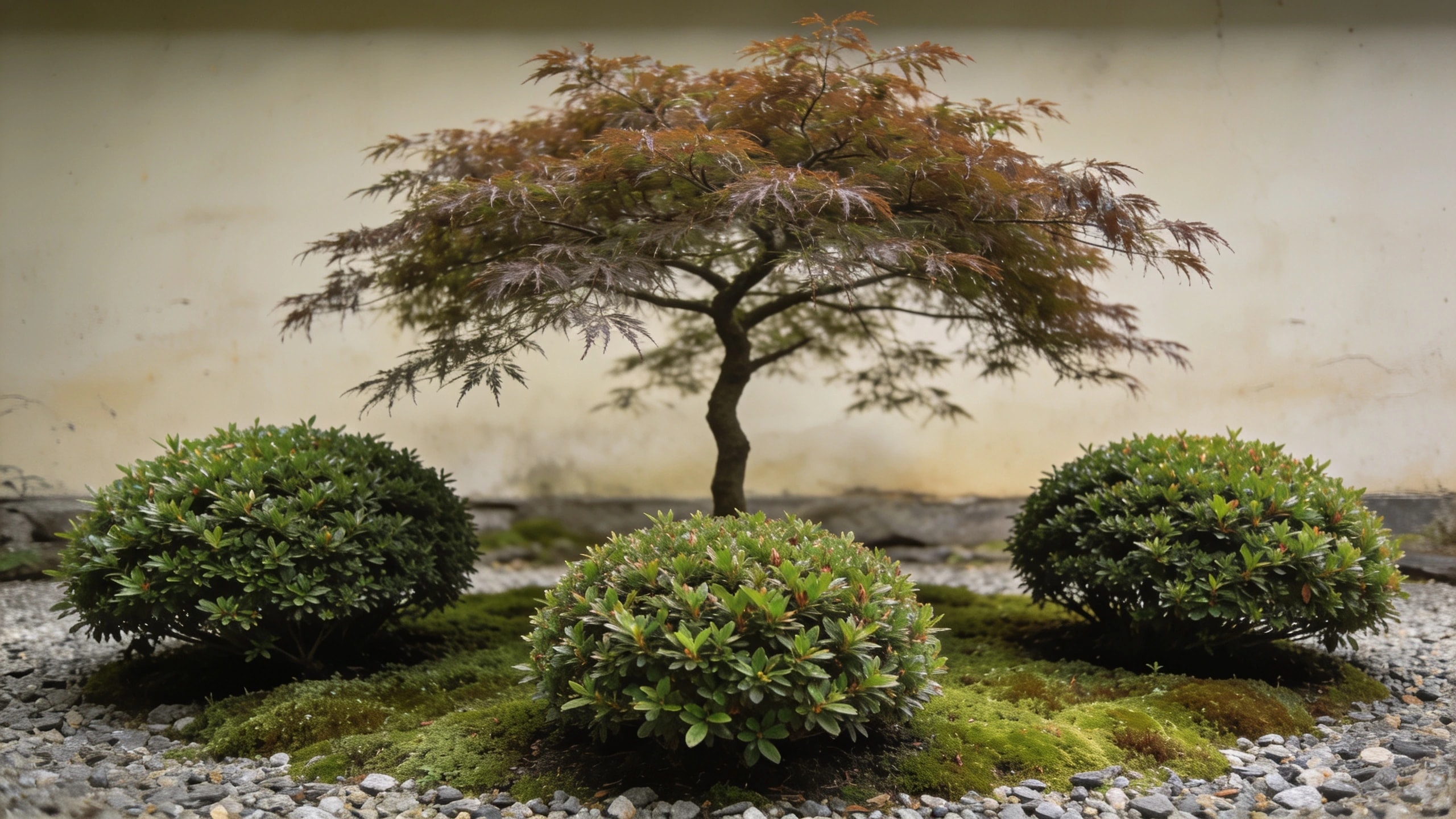
Water, and doing without it#
Water is traditional and it is also the most expensive and highest maintenance element you can add. There are two honest ways to have it.
A single stone basin, a tsukubai, kept filled. Small, quiet, needs a jug rather than a pump. This is the version I would recommend for almost any garden.
Or dry water: gravel raked to suggest a stream bed, with rocks set as though water had shaped them. Costs almost nothing, needs no maintenance beyond raking, and works in a space where a pond never would.
Full ponds are wonderful and they are a different project, with liners, pumps, filtration and algae.
Making a small corner work#
Here is the plan I would follow in a three metre by two metre corner, which is what most people actually have.
Key points
- Choose the viewpoint first: a window, a doorway or a seat. Everything else is arranged for that line of sight.
- Screen what you do not want with a slatted fence or bamboo panel, then frame what you do want beyond it.
- Set one dominant rock and two smaller ones, a third buried, off centre from the viewpoint.
- Plant one maple as the single tree, three clipped azaleas at different sizes, and hakonechloa in the shade.
- Ground layer: gravel raked plain, or moss if the corner is damp and shaded. Not both.
- One object only. A stone basin or a lantern, placed off centre, partly obscured by planting.
The partly obscured detail matters more than it sounds. Revealing something gradually as you move, rather than presenting it head on, is a large part of why these gardens feel considered.
Maintenance: low input, high precision#
Worth being honest about, because this style is often sold as low maintenance and that is only half right.
You will water less, feed less and deadhead almost never. But the look depends on precision: gravel raked clean, moss weeded by hand, azaleas clipped once or twice, a maple pruned thoughtfully in winter rather than sheared.
Pruning a maple is the one skill worth learning properly. You are thinning to reveal the branch structure, taking out crossing growth and opening the layers, not reducing its size. Cut it like a hedge once and it takes years to recover its shape.
If you would rather do one careful hour a month than twenty rushed minutes a week, this style suits you. If the reverse, it will frustrate you.
What to leave out#
Symmetry, in any form. A matching pair of pots either side of a path is the single most European thing you can do.
Ornament collections. A bridge, a lantern, a pagoda and a statue in one small space is a theme park. One object.
Bright mixed colour. The effect depends on green and texture, with colour as a single event: the maple in October, one camellia in February.
Running bamboo. I cannot say this strongly enough. It spreads by underground rhizome, it will cross a boundary, and removing it is a serious job.
What it costs#
- One good rock
- $60 to $250 depending on size and haulage. The highest impact line on this list.
- Japanese maple, 1 to 1.5 m
- $60 to $180. Buy the best shape you can afford, because shape is the whole point.
- Three azaleas
- $40 to $90. Clip them from the start rather than letting them go and correcting later.
- Gravel, 1 tonne
- $70 to $160 delivered. Choose one colour and one grade, and get a bit more than you think.
- Hakonechloa, three plants
- $25 to $50. Splits easily, so three becomes nine in a few years.
- Stone basin
- $80 to $400. The one object, and worth more than four cheaper ones.
- Slatted screen for one boundary
- $120 to $350. Does the framing and screening work that makes the rest read properly.
Where this needs adjusting#
Deep dry shade under conifers will not grow moss, maples or azaleas well. Ferns, hakonechloa and a gravel and rock composition will still work.
A hot, exposed, south facing plot is hard for maples, which scorch. Pines, clipped evergreens and a dry gravel scheme suit it far better.
And if your soil is strongly alkaline, azaleas and camellias will struggle whatever you do. Grow those two in containers of ericaceous compost and plant the ground with things that suit your soil.
Where the guidance here comes from#
The design principles here are the standard ones from Japanese garden tradition, and the small-space adaptations are what I have found works in an ordinary garden. For the horticulture rather than the design, the RHS advice pages cover maple and azalea care and soil pH properly, and the USDA plant hardiness map is worth checking before buying a maple, since they are less tolerant of both extremes than their popularity suggests.
The short version#
Choose the view. Screen and frame. Three or four species repeated, mostly green. An odd number of rocks with a third buried, never evenly spaced. Gravel or moss, not both. One object, off centre, half hidden. Then keep it precise rather than busy.
Related reading#
- Zen garden: how to build a dry gravel garden: the specific karesansui version of all this, with the raking.
- Garden design basics: the underlying order of work, which applies to any style.
- Low-maintenance garden ideas: where this style genuinely is less work, and where it is not.
- Small balcony garden ideas: the container-only version for a balcony.
Frequently asked questions
How do I start a Japanese garden in a small space?
Pick one view and design for it. Japanese garden design is composed to be seen from a specific place, usually sitting down and usually from indoors, so choose the window or the seat first and work outwards from there. A corner of three metres by two, with one good rock, one small tree, gravel and moss, reads more convincingly than a whole garden of scattered features.
What plants are used in a Japanese garden?
A short list, repeated. Japanese maple, pine, azalea, bamboo, hakonechloa grass, moss, fern, hosta and camellia cover almost everything you see. The discipline is in the restraint: three or four species used repeatedly, mostly green, with one moment of colour. A mixed border of twenty different plants will not read as Japanese however Japanese each plant is.
Do I need rocks, and how do I place them?
Rock is the structure of the whole style, so yes. The rules that matter: use an odd number, bury about a third of each one so it looks like it grew there rather than being delivered, group them with one dominant and one or two subordinate, and never space them evenly. One large well-set rock beats five small ones sitting on the surface.
What is the difference between a Japanese garden and a Zen garden?
A Zen garden, properly karesansui, is one specific type: a dry composition of gravel and rock with almost no planting, made for contemplation from a fixed viewpoint. A Japanese garden is the wider tradition and includes strolling gardens, tea gardens, courtyard gardens and pond gardens, most of which are planted and many of which include water.
Is a Japanese garden low maintenance?
Low input, high precision. There is little watering, feeding or deadheading, but the look depends on things being kept exactly so: gravel raked, moss weeded by hand, maples pruned thoughtfully once a year. It suits someone who would rather do one careful hour a month than twenty rushed minutes a week.
What is borrowed scenery?
Shakkei, the deliberate use of something outside your garden as part of the composition: a neighbour's tree, a distant roofline, a hill. You frame what you want with planting and screen everything else, so the eye reads the borrowed thing as part of your garden. In a small space it is the single most useful idea here, because it makes the garden feel far larger than its boundaries.
What should I avoid?
Symmetry, straight lines, and buying a lot of ornaments. Japanese garden design is asymmetric by principle, so a matching pair of anything reads as European. And the fastest way to make a garden look like a theme park is to add a red bridge, a pagoda, a lantern and a Buddha in the same six square metres. One object, placed well, is the whole budget.
Topics in this article
About the author
Jeff has gardened professionally for over twenty years, mostly on heavy clay, and writes everything here from beds he still works himself. More from Jeff Tanun →
Keep reading
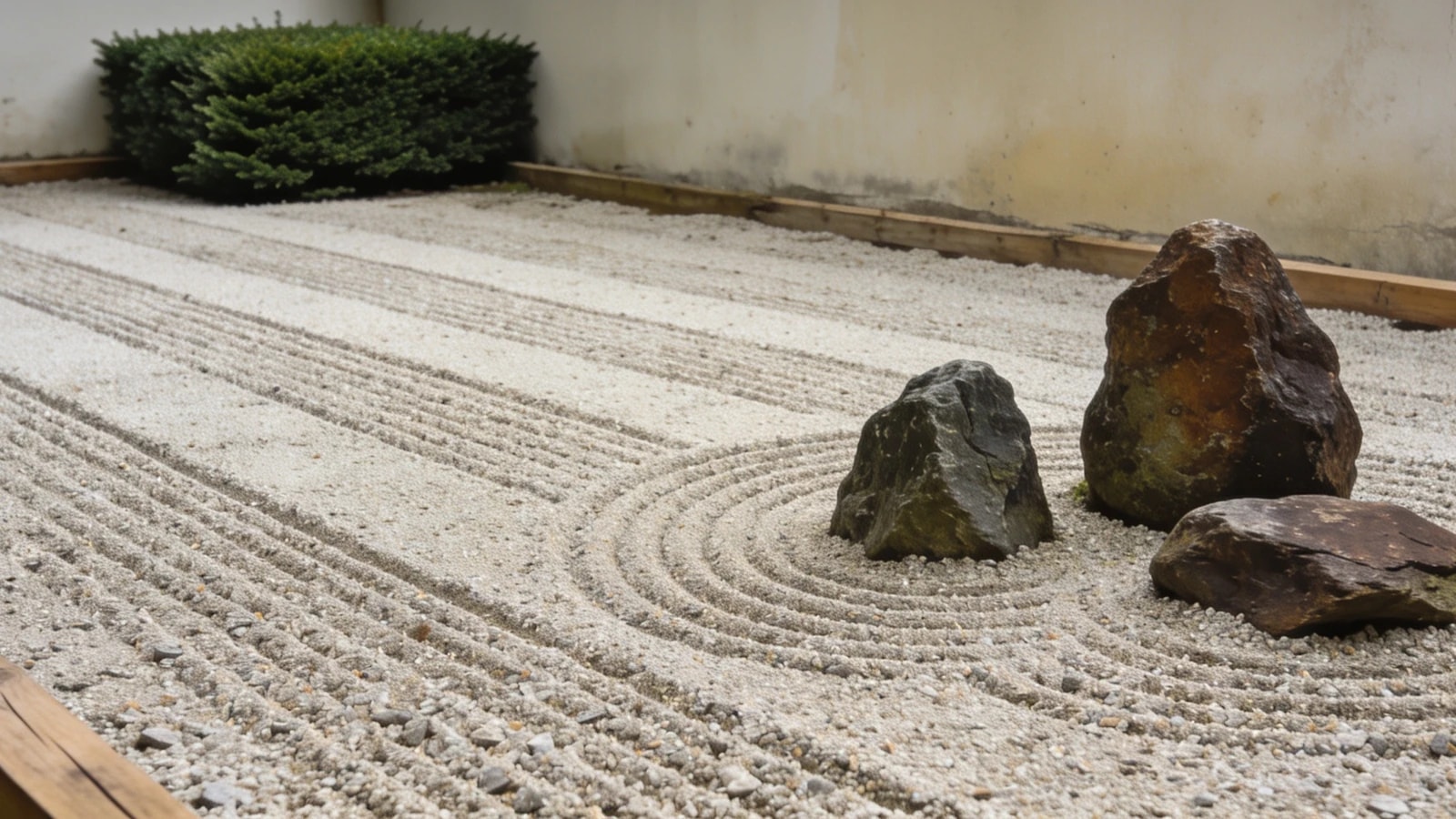
Zen Garden
A zen garden is karesansui: gravel, rock and almost nothing else. What depth of gravel to use, how to set the stones, how to rake it, and what it costs.
Updated
Native Plant Garden
A native plant garden without the purism. Why native means local rather than national, how to find your own list, and where non-natives still earn a place.
Updated
Memorial Garden Ideas
Memorial garden ideas that hold up over decades: choosing a spot, planting with meaning and low upkeep, and what to know before scattering ashes.
Updated