Garden Privacy Screens: Screen the Sightline, Not the Fence
Garden privacy screens that work: why raising the whole boundary is the wrong move, how to block one sightline cheaply, and what to plant for fast cover.
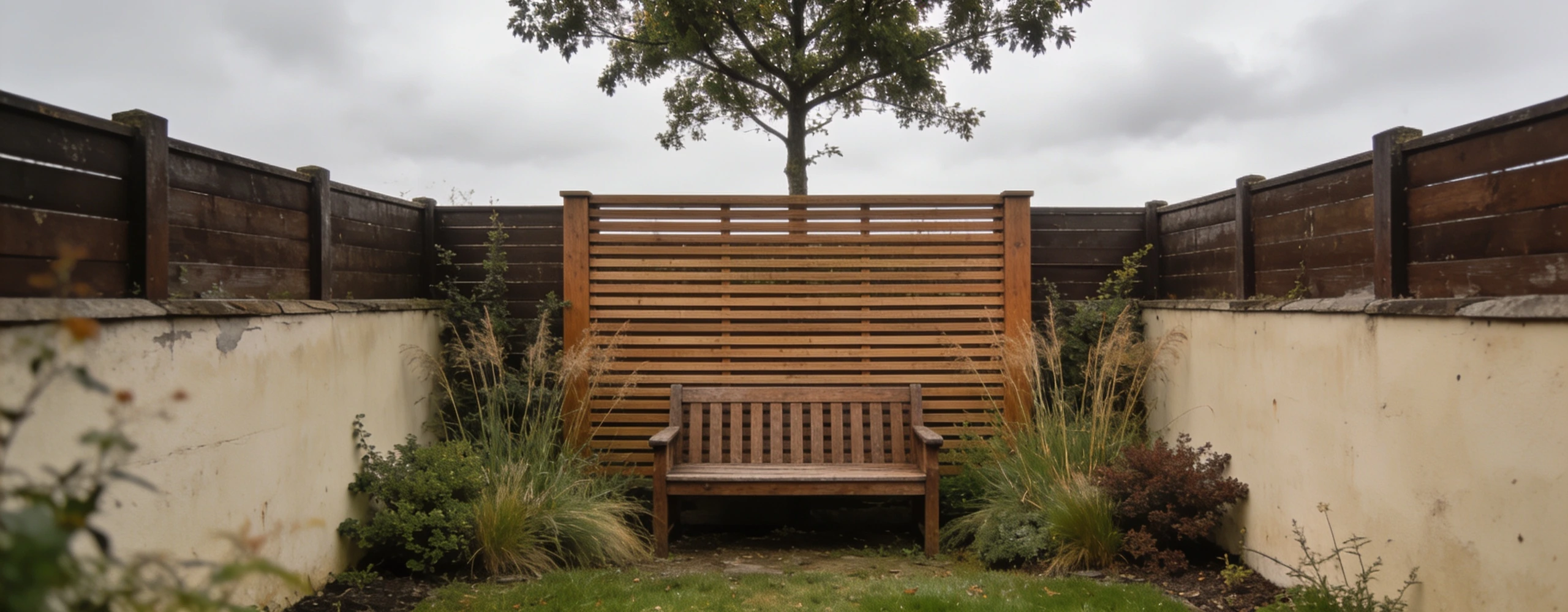
Garden privacy is one of the few problems where the obvious solution is the wrong one. Almost everyone starts by wanting to raise the whole boundary, which is expensive, often against local rules, and less effective than a single well placed panel. The thing you are trying to block is not a fence line. It is a sightline, and there are usually only one or two of them.
The short answer
Sit in the spot you actually use and work out where you are overlooked from. Usually it is one or two places. Screen those, with a freestanding panel set inside the boundary, not the whole fence. For an upstairs window, go overhead instead: a small high-canopy tree or a pergola with a climber. Check the local height limit before buying anything. Annual climbers give cover this summer; evergreen climbers on wires give it permanently in two years.
Find the sightline before you spend anything#
This is the whole method and it takes ten minutes.
Go and sit where you actually sit. Not stand in the middle of the lawn: sit, in the chair, at the height your eyes will be. Then look around and note exactly where you can see a window, a door or a neighbour's seat, and where they could see you.
Almost always there are one or two positions that matter and a lot of boundary that does not. A garden feels private when those one or two are interrupted, regardless of what the rest of the fence is doing.
Key points
- Assess seated, at eye level. Standing up changes every angle and you will screen the wrong thing.
- Mark the sightline with a bamboo cane and a bedsheet before you buy. Two minutes, and it settles the position and height.
- A screen closer to you blocks a wider angle than the same screen at the boundary. Use that: smaller panel, nearer.
- Diagonal views matter more than straight-on ones in most small gardens.
- Upstairs windows cannot be blocked at fence height. That needs a canopy, not a screen.
Check the rules first, because they are lower than you think#
Height is regulated almost everywhere and the limits catch people out after they have bought materials.
In England the usual limit for a boundary fence or wall without planning permission is two metres, and lower where it fronts a highway. Many jurisdictions also have rules about blocking a neighbour's daylight, and some have specific high hedge legislation. Rules differ by country, state and council.
A freestanding screen set inside your own boundary is sometimes treated differently from the boundary structure itself, which is worth a phone call before you commit.
The options, cheapest first#
- Annual climber on a trellis
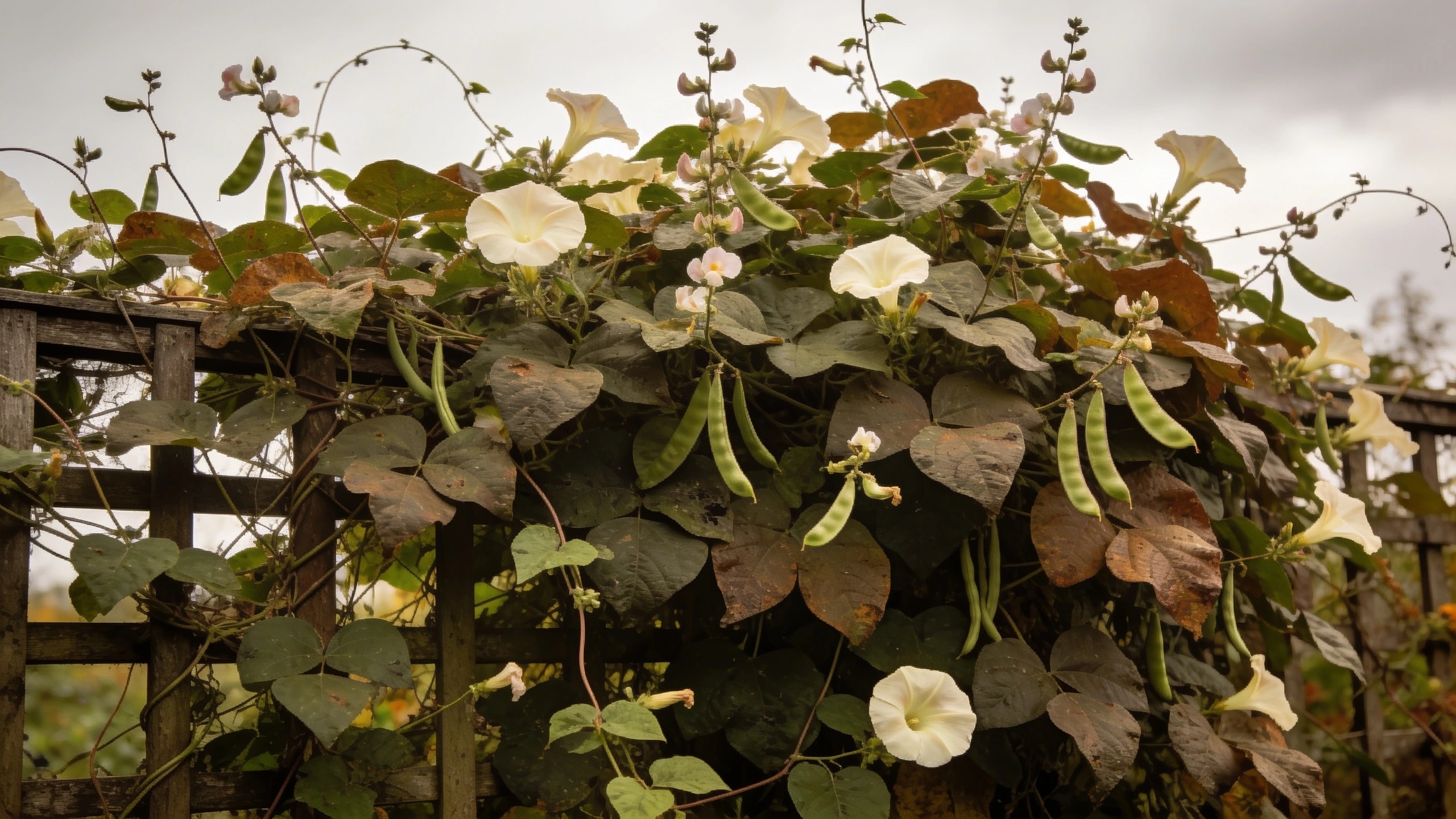
- $20 to $50. Runner beans, morning glory, cup and saucer vine. Two metres of cover by August from seed, then gone in autumn. The fastest and cheapest thing here.
- Reed or willow screening
- $25 to $70 a roll. Cable-tied to an existing fence or railing. Lasts three to five seasons. Ideal on a balcony.
- One slatted timber panel and posts
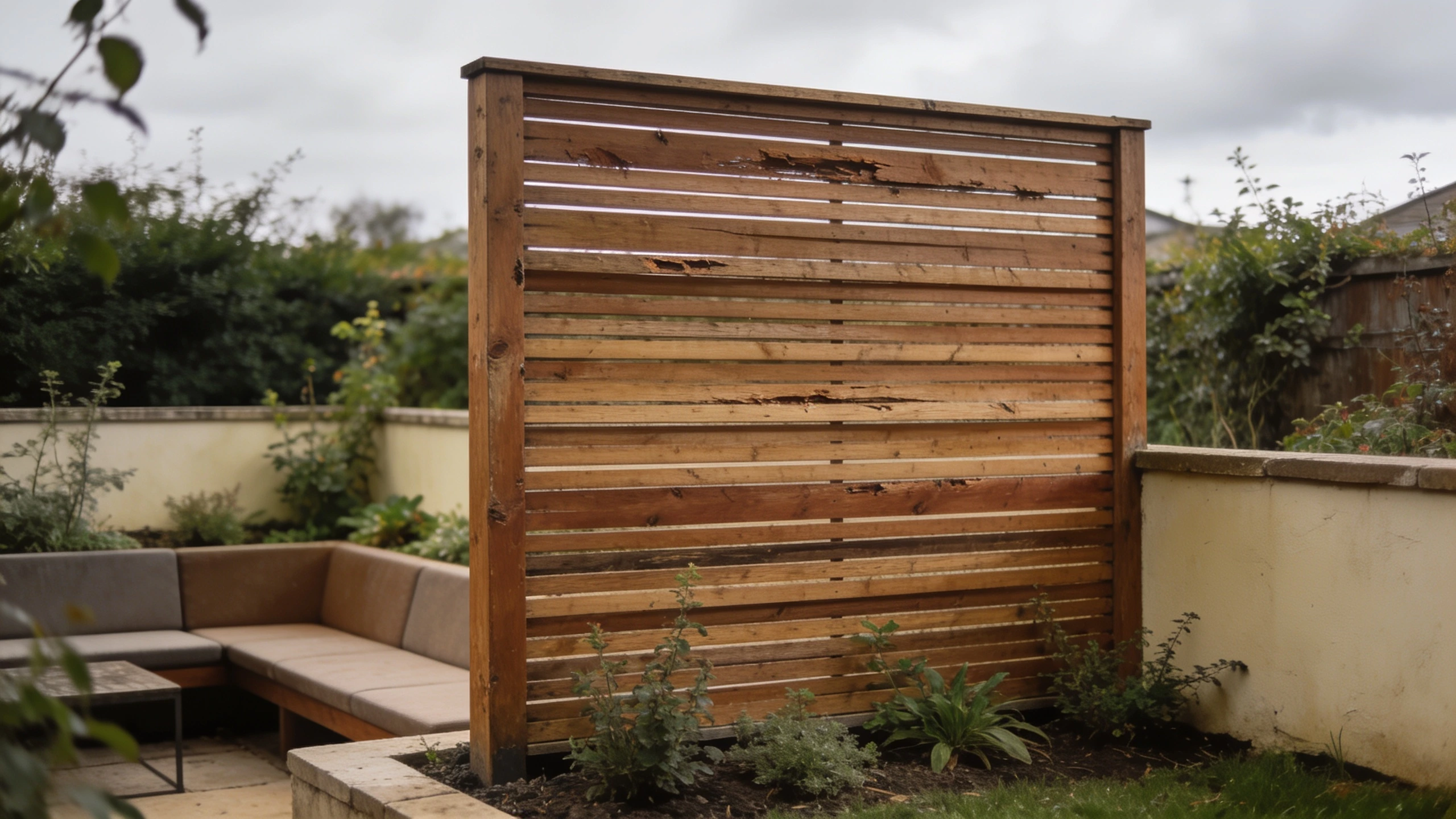
- $120 to $300. Freestanding, positioned on the sightline. The single most effective purchase for most gardens.
- Evergreen climber on wires
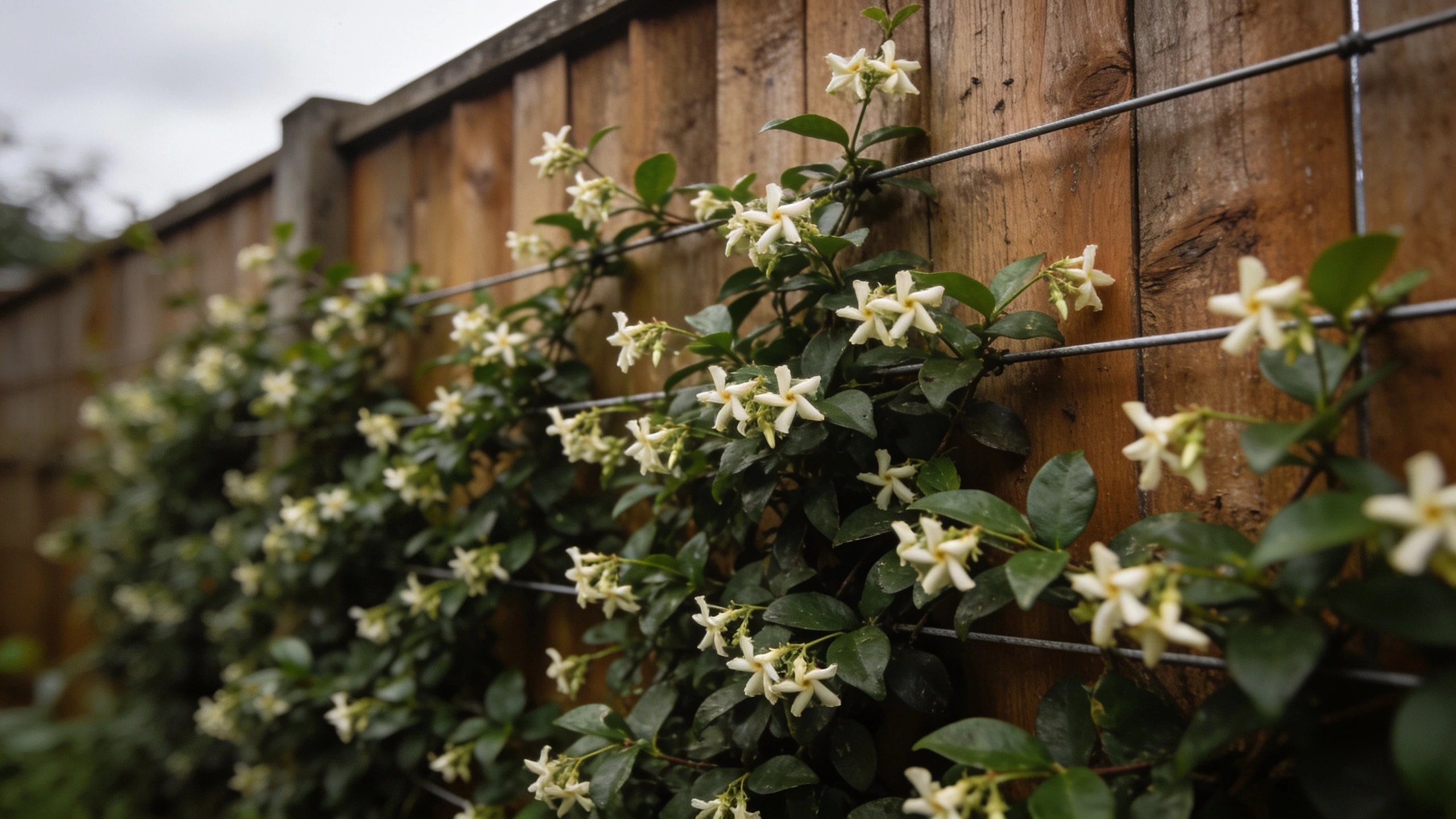
- $40 to $120 plus a morning fitting wires. Star jasmine, evergreen clematis, climbing hydrangea. Permanent green cover in two to three years, and almost no width.
- Pergola with a climber
- $400 to $1,500. The answer to an upstairs window, because it works overhead where a screen cannot.
- One small tree
- $60 to $250. Amelanchier, crab apple, birch if you have room. Interrupts a high sightline at seated head height and looks like a garden rather than a barrier.
- Hedge
- $60 to $180 for ten metres bare root. Cheapest per metre and needs three to five years plus a metre of width.
Climbers on wires: the most under-used answer#
If you want permanent green screening and you do not have a metre of depth for a hedge, this is the one to know about.
Two horizontal wires on vine eyes, held about 5 cm off the fence or wall, and an evergreen climber trained along them. It occupies perhaps 20 cm of depth, gives solid cover in two or three years, and does not add the wind load that a trellis panel does.
- Star jasmine
- Evergreen, glossy, scented in summer. Slow for the first year then reliable. Wants a sheltered sunny or lightly shaded wall.
- Evergreen clematis, armandii
- Fast, dense, scented in early spring. Gets big, so give it a run of fence rather than a narrow panel.
- Climbing hydrangea
- Self-clinging, tolerates a north wall, which almost nothing else on this list does. Slow to start and then permanent.
- Ivy
- Unfashionable, extremely effective, and excellent for wildlife. Keep it off soft mortar and off the house itself.
The upstairs window problem#
A fence cannot solve this, and a lot of money gets spent discovering that.
If you are overlooked from a first floor window, the line of sight comes down at an angle, and no boundary screen at two metres interrupts it. What does interrupt it is something between you and the window at or above your seated head height, close to you rather than close to them.
That means a small tree with a canopy you can sit under, a pergola with a climber over it, or in the short term a large parasol. All three work because they block the angle rather than the ground level view.
A tree is the best of them, because it also looks like a reason for the garden to exist rather than a defensive measure.
Fast cover this summer#
If the problem is now and you are not ready to build, annual climbers are genuinely quick.
Runner beans up a net or wigwam reach two metres by midsummer and you get food. Morning glory and cup and saucer vine do the same job ornamentally. Sweet peas are lower but scented.
All of them need a support in place first, which is the same rule as anything climbing: put the frame up before you plant, not after.
What tends to disappoint#
Solid panels across the full width. They block the view and they also make a small garden feel like a yard, and they take the full force of the wind.
Bamboo in the ground, unless it is a clumping species. Running bamboo spreads by rhizome, crosses boundaries and is a serious job to remove. If in doubt, grow it in a large container.
Fast growing conifers as a screen. They do work and they do not stop at the height you wanted, they go brown if cut back hard, and they are the single most common cause of boundary disputes.
Anything that needs a ladder to maintain. A screen or hedge over about 2.5 m turns an hour's job into a day's, forever.
Where this needs adjusting#
On a balcony, check the lease and the wind loading before attaching anything. Reed screening plus tall grasses in troughs against the wall is the low risk version.
In a windy or coastal garden, slatted screens with gaps outperform solid panels: they filter the wind rather than catching it, and they are far less likely to blow over.
And if the overlooking is from a shared access or a public path rather than a neighbour, planting is usually a better answer than building, because it does not read as hostile.
Where the guidance here comes from#
The sightline method and the position-it-nearer principle are what I worked out after nearly buying forty metres of taller fence panels to solve a problem that turned out to need one screen. For plant choice, climber training and wire fixing the RHS advice pages and the RHS pages on hedges are the references I use. Height limits, light and boundary rules are local law rather than horticulture, so check yours before ordering materials.
The short version#
Sit where you sit, find the one or two sightlines, and screen those. Position the screen near you rather than at the boundary, because a smaller panel blocks a wider angle. Check the height rules first. Use an evergreen climber on wires where depth is tight, a tree or pergola for an upstairs window, and annual climbers if you need cover this summer.
Related reading#
- Hedging plants: the living boundary version, and how long it really takes.
- Vertical gardening: supports, wind load and how to build a frame that stays up.
- Garden design basics: why enclosure in one spot makes a garden feel larger, not smaller.
- Small balcony garden ideas: screening where you cannot dig or fix anything permanent.
Frequently asked questions
What is the cheapest way to get privacy in a garden?
Screen the sightline rather than the boundary. Sit in the spot you actually use, work out the one or two places you are overlooked from, and block just those. A single two metre panel positioned correctly does more than raising forty metres of fence, and costs a fraction. Almost everyone starts by trying to raise the whole boundary and it is the expensive way round.
How high can I make a garden fence or screen?
Check locally before you buy anything, because this is regulated almost everywhere and the limits are lower than people expect. In England the usual limit without planning permission is two metres, and lower next to a highway. Many areas also have rules about blocking a neighbour's light. A freestanding screen inside your boundary is often treated differently from the boundary fence itself, which is worth asking about.
What is the fastest growing plant for privacy?
For a screen this season, an annual climber: runner beans, morning glory or a cup and saucer vine on a trellis will cover two metres by August. For permanent cover, evergreen clematis, star jasmine or a climbing hydrangea on wires give you a green wall in two or three years without the width a hedge needs. Bamboo works and only clumping species, never running.
Do I need trellis on top of my fence?
Often not, and it is the option most likely to cause problems. Trellis added to a fence increases the wind load on posts that were not designed for it, and it may take you over the local height limit. A freestanding screen set a metre inside the boundary, at the point where the sightline actually is, is usually cheaper, more effective and less contentious.
How do I get privacy from an upstairs window overlooking me?
You cannot block an upstairs view with a fence, so stop trying. The answer is overhead: a small tree with a high canopy, a pergola with a climber over it, or a large parasol. A tree planted between you and the window interrupts the line of sight at head height when you are sitting, which is all you need.
What about privacy on a balcony?
Reed or willow screening cable-tied to the railing, plus tall planted grasses in troughs, does most of it. Check your building rules first, because many leases restrict what can be attached to a balcony and anything solid adds a wind load the railing may not be rated for. Keep the heavy planters against the wall rather than the edge.
Will a screen make my garden feel smaller?
A solid screen across the whole width will. Screening only the sightline usually makes a garden feel bigger, because it creates a sense of enclosure in one spot and leaves the rest open. Slatted screens with gaps also read as lighter than solid panels while blocking a diagonal view almost as well.
Topics in this article
About the author
Jeff has gardened professionally for over twenty years, mostly on heavy clay, and writes everything here from beds he still works himself. More from Jeff Tanun →
Keep reading
Hedging Plants
Hedging plants compared by growth rate, cost and upkeep. What to plant for privacy, how many per metre, and the two mistakes that cost you a whole season.
Updated
Native Plant Garden
A native plant garden without the purism. Why native means local rather than national, how to find your own list, and where non-natives still earn a place.
Updated
Permaculture Garden
A permaculture garden without the ideology. Zones, stacking and catching water are genuinely useful; some of the rest is untested. What to take and what to leave.
Updated