Zen Garden: How to Build a Dry Gravel Garden
A zen garden is karesansui: gravel, rock and almost nothing else. What depth of gravel to use, how to set the stones, how to rake it, and what it costs.
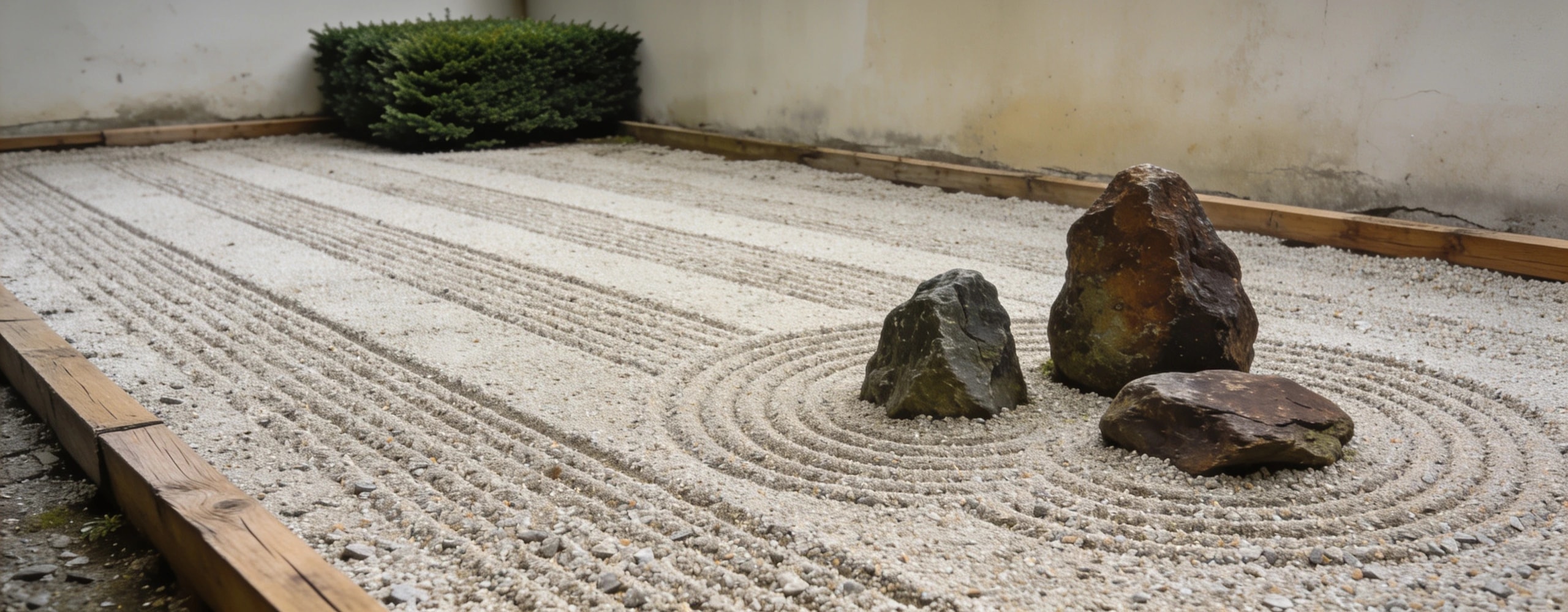
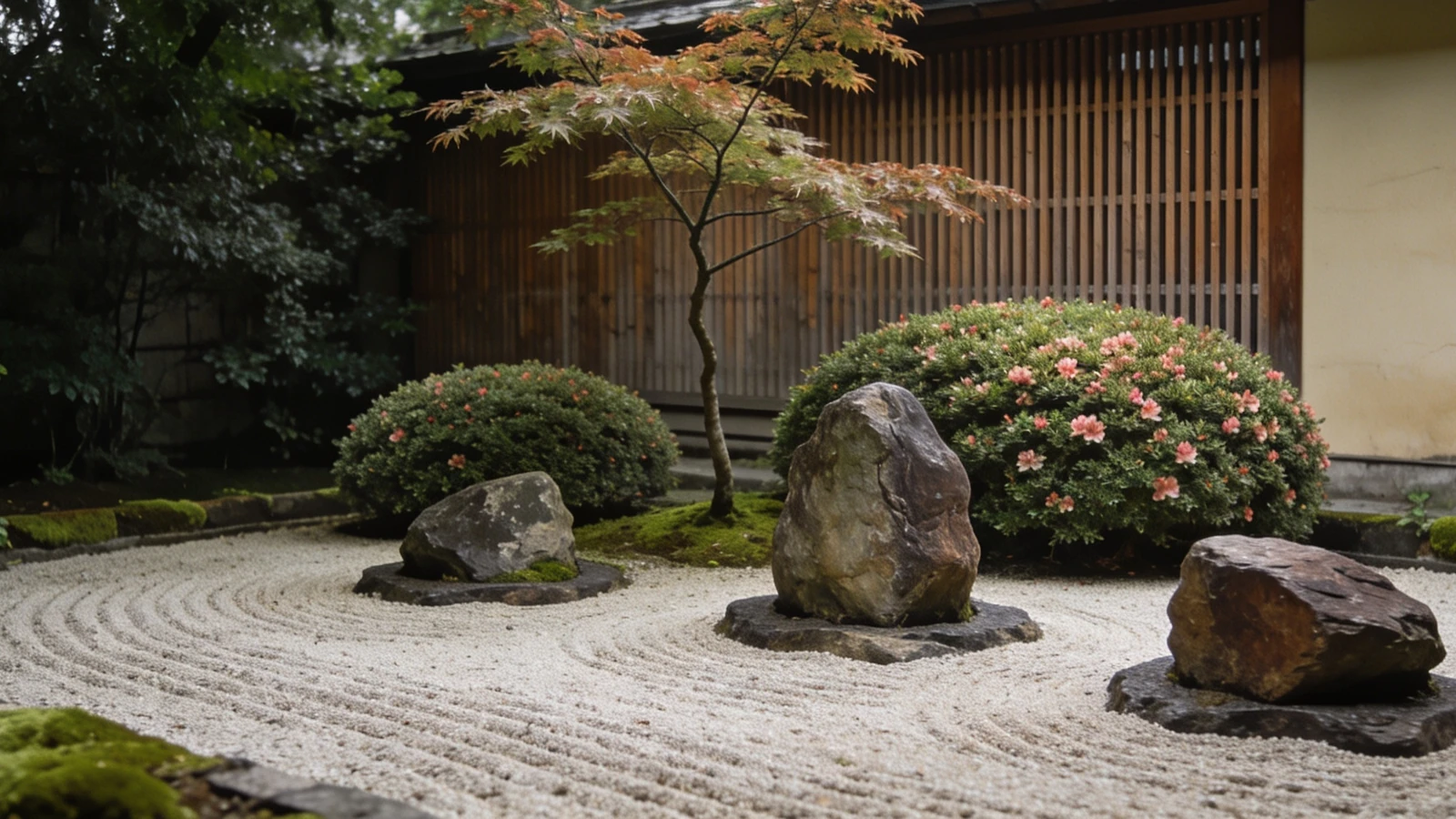
A zen garden is a much more specific thing than the phrase suggests. Properly it is karesansui, a dry landscape of raked gravel and set stone with almost no planting, and it is the easiest Japanese style to build well in a small space because it removes the two hardest variables: water and horticulture. I built one in a shaded corner where nothing would grow, and it is the least trouble and most looked-at part of my garden.
The short answer
Use angular crushed grit at 2 to 5 mm, laid 5 to 7 cm deep over woven landscape fabric. Rounded pea gravel will not hold a raked line, so this choice is not cosmetic. Set an odd number of rocks with a third of each buried, off centre and unevenly spaced. Rake straight lines across the open ground and concentric rings around each rock, working backwards towards your viewpoint. Two metres by one and a half is enough.
Gravel: the one decision that determines everything#
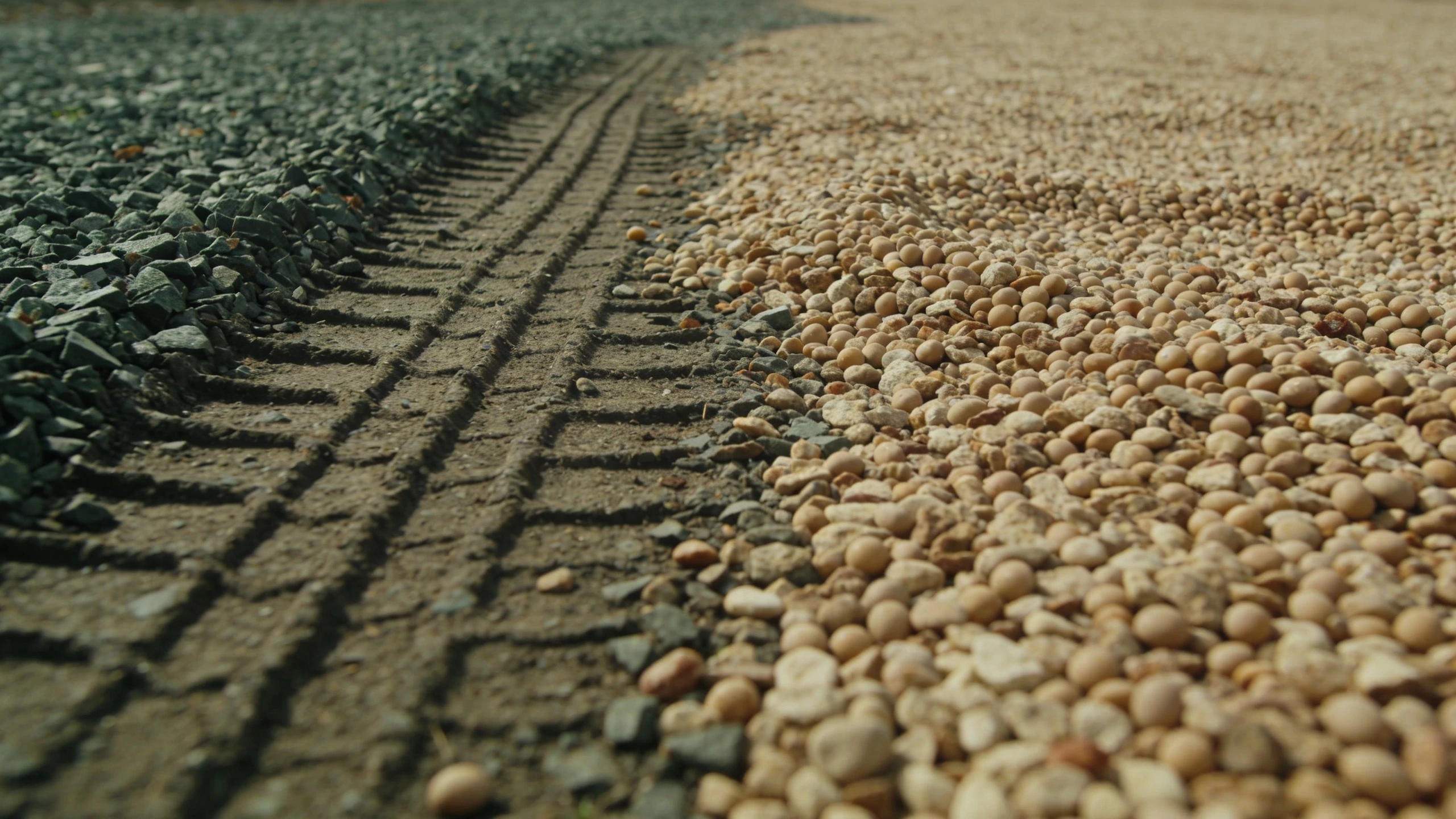
If you get one thing right, make it this. Angular crushed stone holds a raked line. Rounded gravel does not, it collapses back into a flat surface within hours, and no amount of raking will change that.
So: crushed granite, grit or decomposed granite, 2 to 5 mm, in a pale grey or off white. Ask a stone merchant for angular grit rather than pea gravel and they will know exactly what you mean.
Depth is the second half of it. Five to seven centimetres. Any shallower and the rake catches the membrane underneath and drags it up. Much deeper and it is unpleasant to walk on, harder to rake cleanly and you are paying for stone nobody sees.
Building it, in order#
The whole job is a weekend and most of it is preparation rather than skill.
Key points
- Choose the viewpoint first. This garden is composed to be seen from one place, usually a seat or a window, and usually sitting down.
- Mark the shape and dig out 10 to 12 cm, keeping the base roughly level and firm.
- Edge it properly. Timber, steel or a course of stone. Without an edge the gravel migrates into the lawn and the lawn into the gravel.
- Lay woven landscape fabric with generous overlaps. This is one of the few places membrane belongs, because nothing is planted through it.
- Set the rocks before the gravel goes in, so you can bury a third of each properly and cut the fabric around them.
- Then gravel to 5 to 7 cm, rake level, and leave it a week before you rake a pattern. It settles.
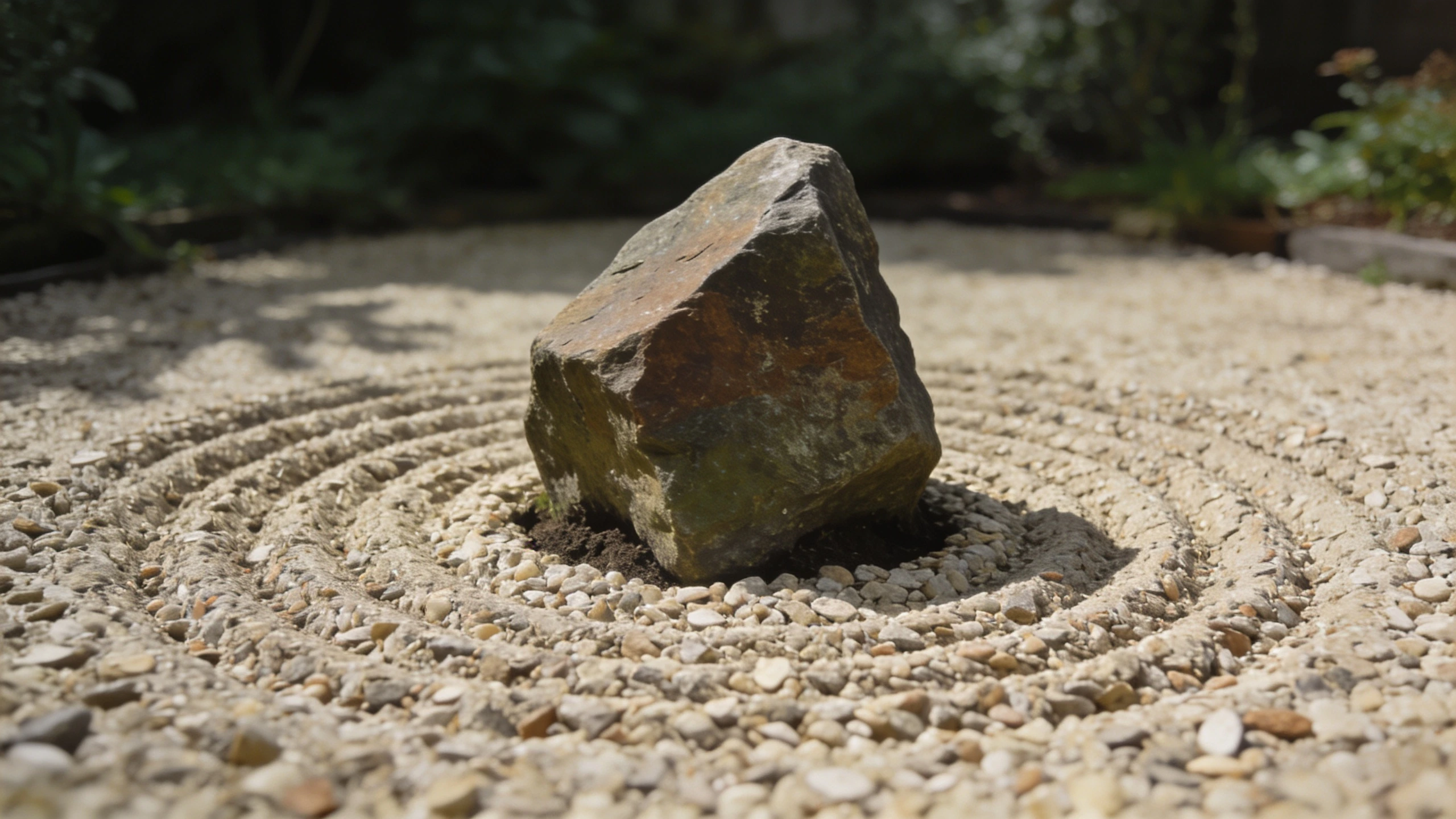
Setting the rocks is the part worth slowing down for. Stand each one up, look at it from the viewpoint you chose, and turn it until the best face is towards you. Then bury a third. A rock resting on the surface always looks delivered.
Raking, and the two patterns that matter#
Two patterns cover almost everything you see in the tradition.
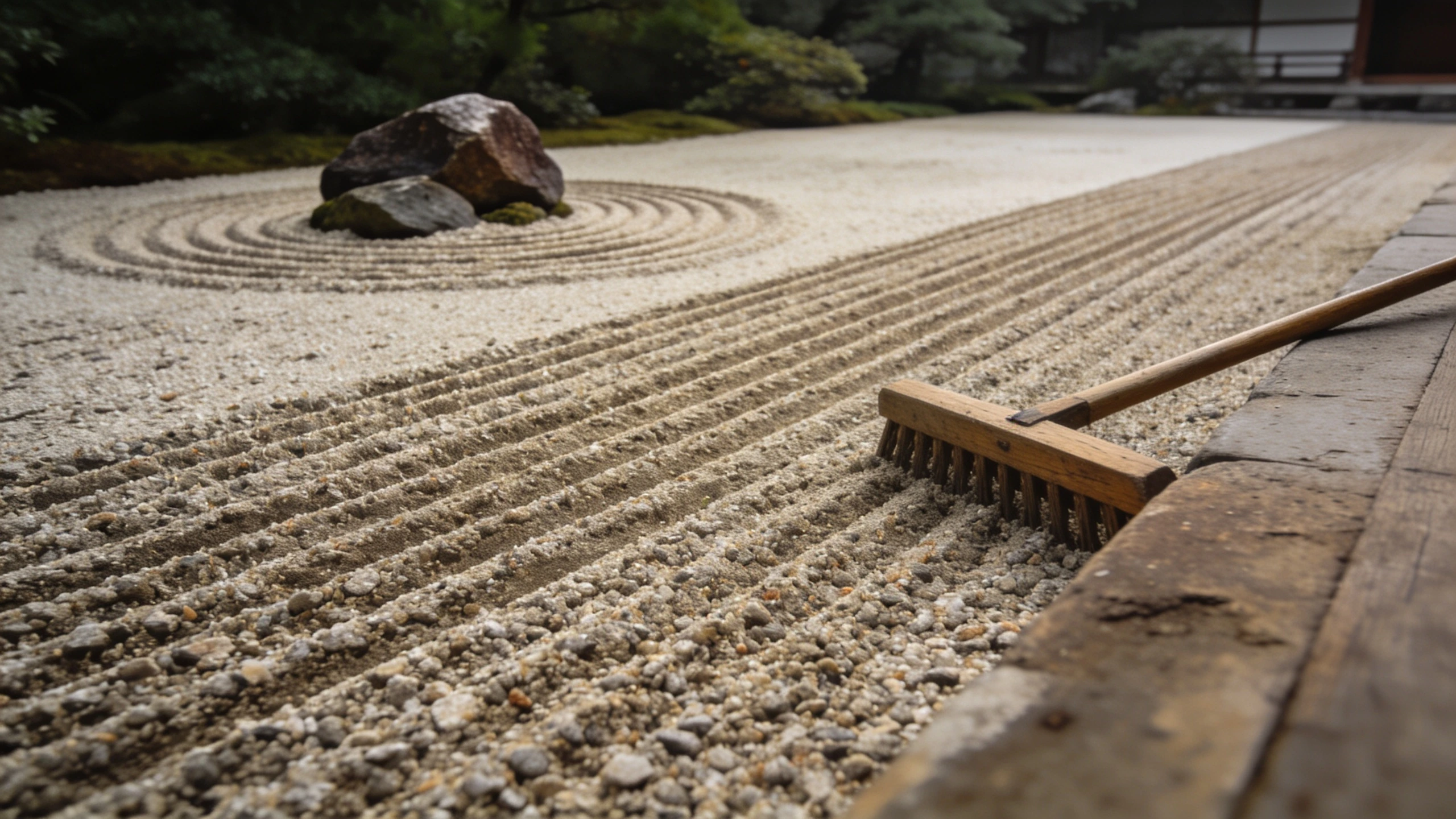
Straight parallel lines across the open ground, running in the direction that suits the shape of the space. This is the water surface.
Concentric rings around each rock or group, as though the stone had dropped into that water and sent ripples out. Two or three rings is plenty; more looks fussy.
Practical points that make the difference. Work backwards, from the far edge towards your viewpoint, so you are never standing on what you have just done. Rake in one continuous pass rather than short strokes. And accept that it will not be perfect, because it is not supposed to be.
A wooden rake with teeth roughly 4 cm apart gives the classic spacing. A standard metal garden rake produces lines that are too fine and too close together, and the effect is closer to a comb than a composition.
What to plant, which is almost nothing#
The restraint is the point, and adding plants is the most common way people dilute the effect.
If you want any planting at all, keep it to the edges and keep it to one or two things. Moss where it is damp and shaded. A single clipped evergreen mound. One small Japanese maple set outside the gravel, so its shadow falls across it.
What does not work is scattering plants through the gravel. The gravel needs to read as an uninterrupted surface, and anything growing out of the middle of it breaks that and makes raking impossible.
Upkeep, honestly#
This is the lowest maintenance garden style I know, and it is not zero.
A rake through every week or two through the growing season keeps it looking intentional. Leaves cleared in autumn, which is the one real chore, and a reason not to put it directly under a deciduous tree. A few weeds pulled where seed has blown in and germinated on the surface, which happens however good the membrane is.
Top the gravel up every few years, because some works down into the base and some leaves with the shoes of anyone who walks on it.
Ten minutes at a time, but it does need to be that ten minutes. Left for two months it stops reading as a composition and starts reading as a gravel patch.
What it costs#
For a two metre by one and a half metre garden, which is a realistic small corner.
- Angular grit, half a tonne
- $45 to $110 delivered. Buy 20 percent more than the calculation says. Everyone runs short.
- Woven landscape fabric
- $15 to $35. Woven, not plastic sheet, so water still drains through.
- Edging, timber or steel
- $30 to $120. Do not skip it. Unedged gravel migrates and the garden loses its shape in a season.
- Three rocks
- $80 to $300 with haulage. The single biggest visual investment, and the one worth overspending on.
- Wooden rake
- $25 to $60, or make one from a batten and dowels in an afternoon.
- Total
- Roughly $200 to $600, and it needs no watering, feeding or replanting ever.
The desktop version, and why it is not silly#
Most things sold as zen gardens are miniature trays of sand with a tiny rake. It is easy to be snobbish about them and I would not be.
They work on their own terms: a small tray, fine sand rather than grit, two or three pebbles, raked while thinking about something else. If a two metre corner is not available, a tray on a desk is a legitimate small version of the same idea rather than a parody of it.
The one adjustment I would make is to use fine sand rather than the coloured grit some kits supply, because fine sand takes a much crisper line at that scale.
When this is the wrong choice#
Directly under a deciduous tree. You will spend every autumn picking leaves out of gravel with your fingers, because a rake takes the gravel with them.
Anywhere children play football. Gravel gets kicked, and it does not come back.
On a balcony without checking the loading. Half a tonne of wet stone is a structural question, not a design one.
And if you want flowers, this is not the style. It is a composition in grey and green, and adding colour to fix that means you wanted a different garden.
Where the guidance here comes from#
The gravel grade, depth and construction detail are what I arrived at building one and correcting it twice, the first time with pea gravel that would not hold a line. The design principles are the standard karesansui ones. For anything about plants at the edges, soil and pH, the RHS advice pages are the reference, and Garden Organic is worth reading on keeping gravel weed-free without herbicide, which is entirely possible here because the surface is loose.
The short version#
Angular grit, 2 to 5 mm, 5 to 7 cm deep on woven fabric, properly edged. Odd number of rocks, a third buried, off centre, unevenly spaced. Straight lines across the open ground and rings around the stones, raked backwards towards the seat you built it for. Then leave it almost entirely alone.
Related reading#
- Japanese garden ideas that work in a small space: the wider tradition, including the planted versions.
- Low-maintenance garden ideas: where else you can cut work without cutting quality.
- Garden design basics: choosing the viewpoint, which this style depends on entirely.
- Small balcony garden ideas: the weight question, and what a balcony can carry.
Frequently asked questions
What actually is a zen garden?
Karesansui, meaning dry landscape. A composition of raked gravel and set rock with little or no planting, developed at Japanese temples as something to be contemplated from a fixed viewpoint rather than walked through. The gravel stands in for water and the rocks for islands or mountains. Most things sold as zen gardens are miniature desktop versions of this.
What gravel should I use for a zen garden?
Angular crushed granite or grit at 2 to 5 mm, in a pale grey or off-white. Angular matters because it holds a raked line; rounded pea gravel collapses and will not keep a pattern. Lay it 5 to 7 cm deep over a weed membrane. Shallower than 5 cm and you rake through to the membrane, deeper than about 8 cm and it is hard to walk on and wasteful.
How do you rake a zen garden?
Straight parallel lines across the open ground, and concentric rings around each rock, as though the rock had dropped into water. Work backwards so you do not walk on what you have just raked, and rake from the far edge towards the viewpoint. A wooden rake with teeth about 4 cm apart gives the classic spacing; a metal garden rake makes lines that are too fine and too close.
Is a zen garden low maintenance?
Genuinely, more so than any planted scheme. No watering, feeding or pruning. What it does need is a rake through every week or two in the growing season, leaves cleared in autumn, and the odd weed pulled where seed has blown in. Ten minutes rather than an hour, but it has to be that ten minutes or it stops looking intentional.
Can I have a zen garden in a small space or on a balcony?
Yes, and small suits it. Two metres by one and a half is enough for a composition of three rocks and raked gravel. On a balcony, use a shallow timber tray with a liner so you are not loading the structure with a tonne of stone, and remember that gravel plus damp is heavy: check what your balcony is rated for before you build anything.
How many rocks and where do I put them?
An odd number, usually three, five or seven, in groups with one dominant stone. Bury about a third of each so it looks like it grew there. Place them off centre from the viewpoint and never evenly spaced. The traditional test is that you should not be able to see all the stones at once from every angle, so one is always partly hidden.
Do I need a weed membrane?
Yes, under a gravel garden it is one of the few places membrane genuinely earns its place, because nothing is being planted through it. Use a woven landscape fabric rather than plastic sheet so water still drains, overlap the joins generously, and cut it around the rocks after they are set rather than before.
Topics in this article
About the author
Jeff has gardened professionally for over twenty years, mostly on heavy clay, and writes everything here from beds he still works himself. More from Jeff Tanun →
Keep reading
Japanese Garden Ideas
Japanese garden ideas built on the actual principles: asymmetry, borrowed scenery and restraint. What to plant, what to leave out, and a plan for a small corner.
Updated
Native Plant Garden
A native plant garden without the purism. Why native means local rather than national, how to find your own list, and where non-natives still earn a place.
Updated
Memorial Garden Ideas
Memorial garden ideas that hold up over decades: choosing a spot, planting with meaning and low upkeep, and what to know before scattering ashes.
Updated