Hydroponic Gardening: What It Is Good At, and What Not
Hydroponic gardening explained without the hype: which systems suit a beginner, what it costs to run, what grows well in water, and what does not.
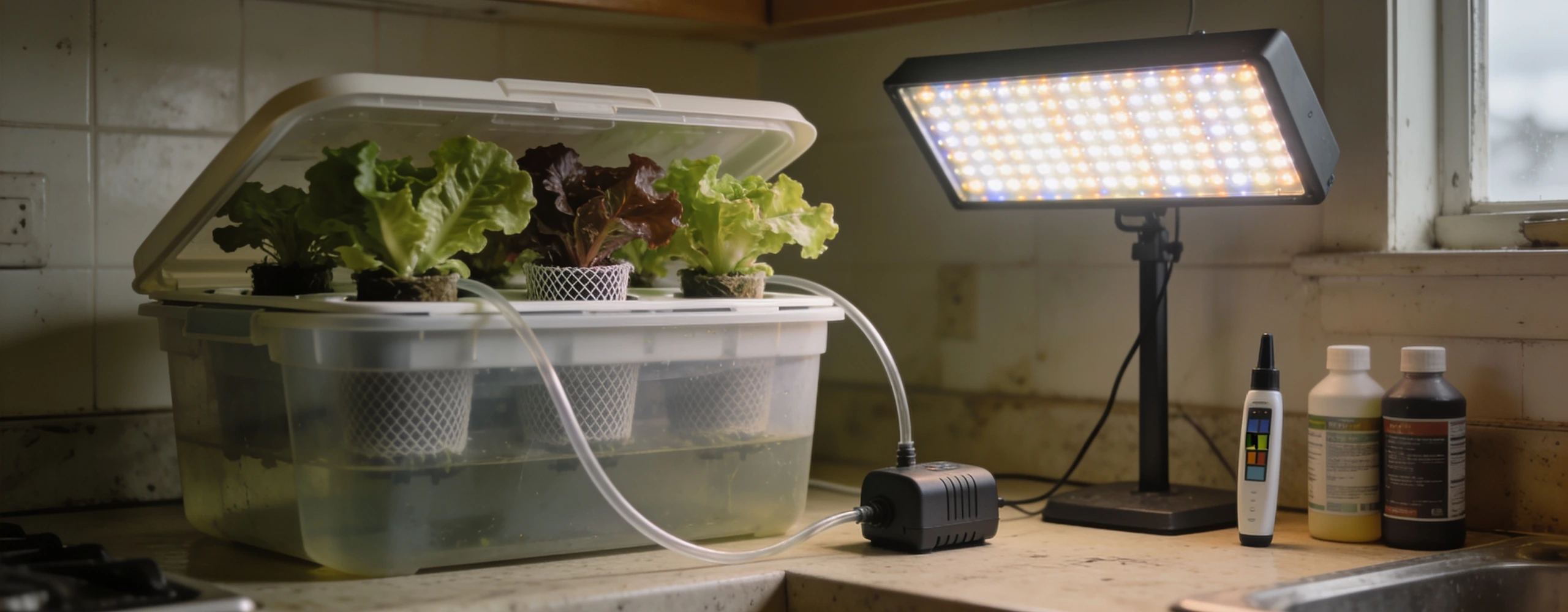
Hydroponic gardening gets sold either as the future of food or as an expensive gimmick, and neither is much use if you just want to know whether to try it. My own view after running a small system through two winters is narrower and more useful: it is very good at a few things and a poor choice for most of what people grow.
The short answer
Start with deep water culture: a lidded opaque tub of nutrient solution with a cheap air pump. Grow leafy salad and herbs, which is what hydroponics is genuinely best at. Budget $50 to $120 to start and $4 to $7 a month in electricity for a small LED. Use opaque containers to stop algae, keep the reservoir under about 22C to stop root rot, and remake the solution every two to three weeks rather than topping up forever.
What hydroponics is actually good at#
Worth being specific, because the honest case is narrower than the marketing and stronger for being narrow.
Key points
- Growing where there is no soil and no outdoor space at all. A worktop, a spare room, a cupboard.
- Growing through winter, when nothing outdoors is producing anything you would want to eat.
- Speed. Leafy crops come to cutting size noticeably faster than in soil, because the roots never search for anything.
- Total control of the root zone. No slugs, no soil pests, no weeds, no digging.
- Water efficiency. A recirculating system uses a fraction of what the same crop takes in open ground.
And what it is bad at: anything cheap and easy to grow in soil outdoors in summer, anything you want to store, and anything that needs depth. If you have a garden and it is June, soil wins on every measure including flavour, effort and cost.
The systems, from simplest upwards#
There are half a dozen recognised methods and a beginner really only needs to consider the first two.
- Kratky
- A sealed tub of solution, plants in the lid, no pump at all. The water level drops as the plant drinks and air fills the gap. One crop per fill. The cheapest possible start.
- Deep water culture
- The same but with an air pump bubbling the solution. Faster growth, far more forgiving, and still almost nothing to go wrong. This is what I would start with.
- Ebb and flow
- A tray flooded from a reservoir on a timer, then drained. Good for several plants at once. More plumbing and a pump that can fail.
- Nutrient film technique
- A thin film of solution running down a sloped channel. Efficient and commercial. Unforgiving of a pump failure, which kills a crop in hours.
- Drip systems
- Solution dripped onto each plant in an inert medium. Good for tomatoes and larger fruiting plants. Emitters block.
- Aeroponics
- Roots misted in air. Highest performance, highest complexity, and not a first project.
The three failures, and how to avoid all of them#
Almost every hydroponic disappointment is one of these, and each has a simple answer.
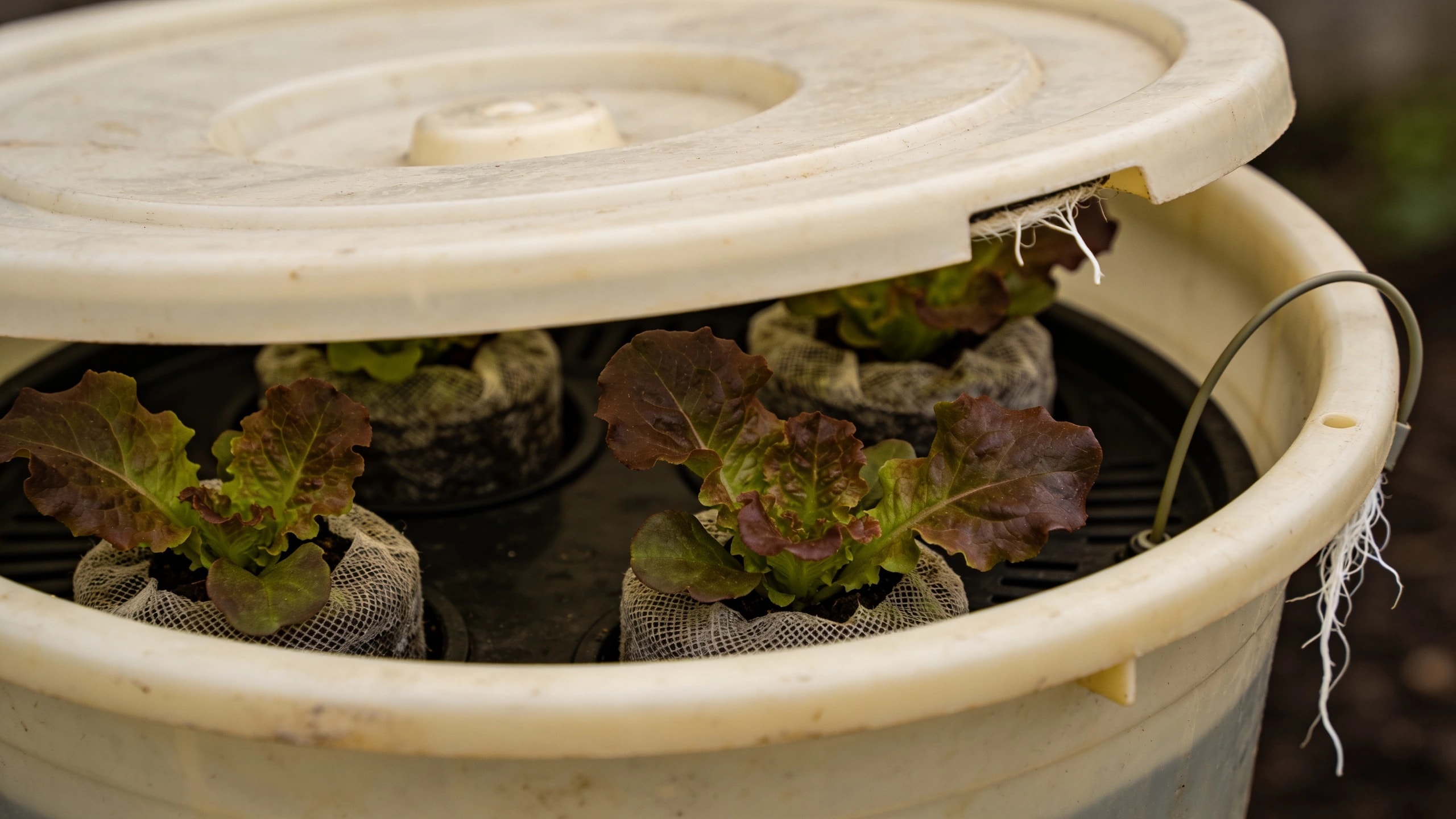
Algae. Light reaching the nutrient solution grows algae, which competes for nutrients and fouls pumps. The answer is opaque everything: an opaque reservoir, a lid with no gaps, and a collar round each plant. Clear tubs look better in photographs and are the single most common beginner mistake.
Root rot. Warm, still, oxygen-poor water. The answer is an air pump and keeping the reservoir below roughly 22C, which mostly means keeping it off a sunny windowsill and off a warm floor. Healthy roots are white and smell of nothing. Brown, slimy roots that smell are the warning.
Nutrient drift. Plants take up water and nutrients at different rates, so topping up with plain water for a month leaves you with a solution that is nothing like the recipe. The answer is unglamorous: dump it, rinse the reservoir and remake the solution every two to three weeks.
Nutrients, pH and the two numbers to watch#
This is the part that sounds technical and is genuinely simple once set up.
Buy a two-part or three-part hydroponic nutrient rather than a general houseplant feed. Soil feeds are formulated on the assumption that soil supplies the trace elements, and in water there is no soil to do it.
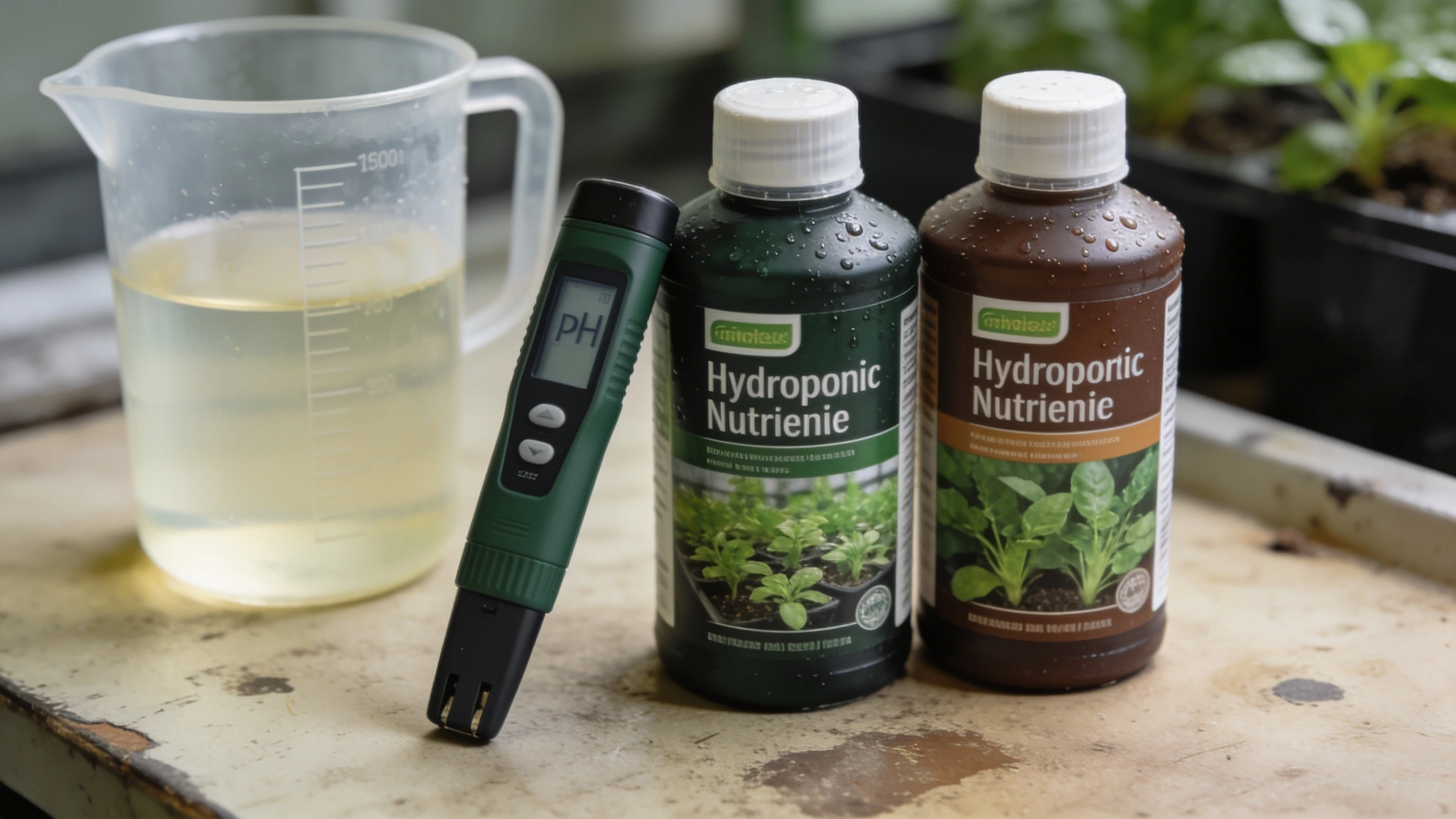
Two measurements matter. pH between 5.5 and 6.5 for most leafy crops, because outside that range the plant physically cannot take up some nutrients even when they are present in the water. And electrical conductivity, which tells you how concentrated the solution is; start at the low end of whatever the bottle says, because underfeeding is far easier to correct than overfeeding.
A cheap pH pen and a bottle of pH down cover it. You are checking twice a week, not daily.
Lighting is where the money goes#
The nutrients cost almost nothing. The electricity is the running cost, and it is worth doing the arithmetic before you buy.
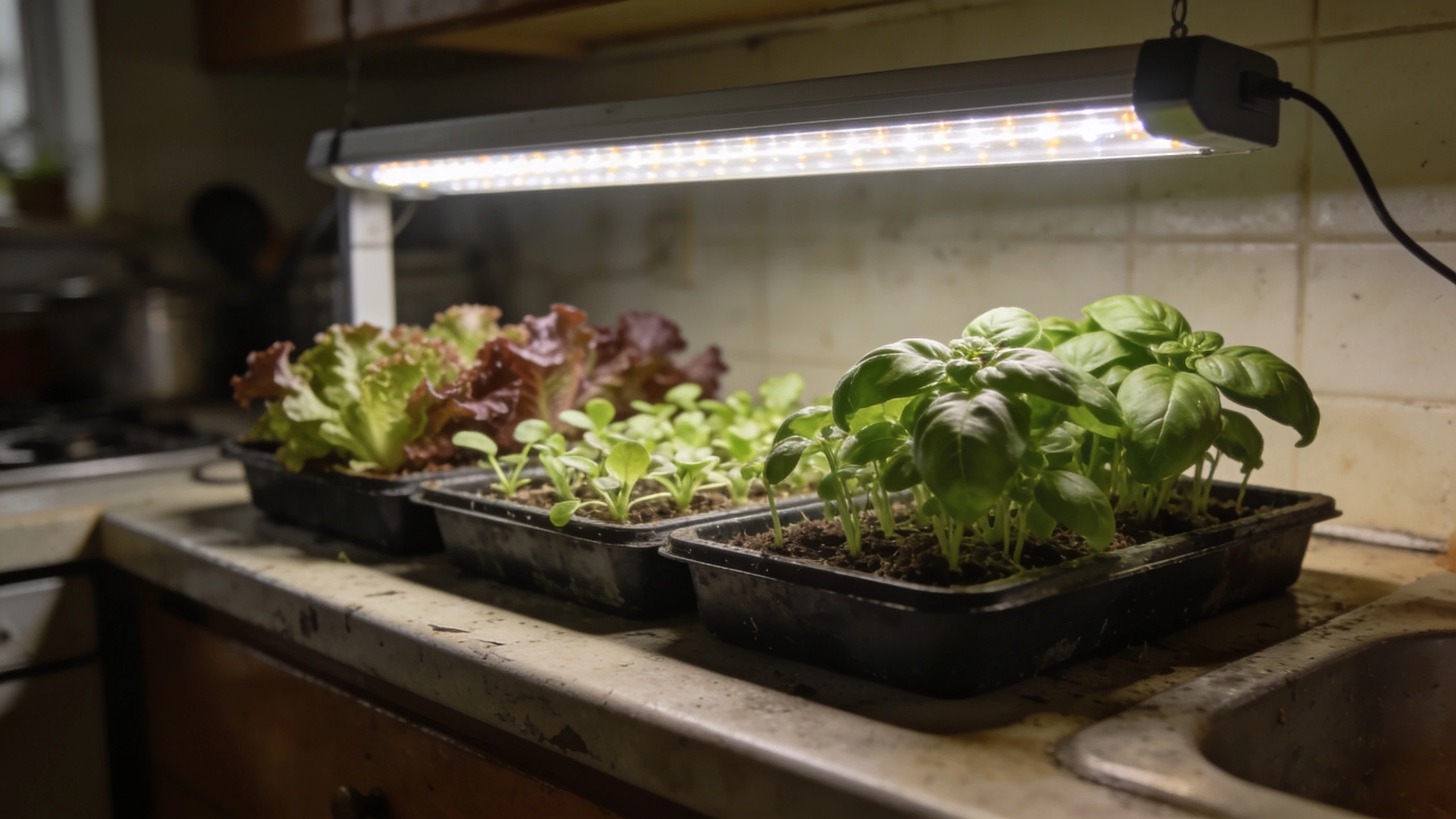
A small LED panel of 30 to 60 watts, run 14 hours a day, uses roughly 0.4 to 0.8 kWh daily. At around 30 cents a unit that is about $4 to $7 a month, which is reasonable for winter salad you cut fresh.
A 300 watt setup on the same schedule is nearer $35 a month. That is more than the value of what most people grow in it, so if you scale up, do it because you enjoy it rather than because you expect to save money.
Positioning matters more than wattage for leafy crops: 20 to 40 cm above the plants, on a timer, 14 to 16 hours. Too far away and lettuce stretches and goes leggy.
What to grow, and what to skip#
- Excellent
- Lettuce, salad leaves, spinach, chard, pak choi, basil, mint, coriander, parsley. Fast, shallow rooted, cut repeatedly.
- Works with more effort
- Tomatoes, chillies, cucumbers, strawberries. Bigger system, support needed, fussier about nutrients as they fruit.
- Poor fit
- Carrots, parsnips, potatoes, onions and garlic. All want depth, and the storage crops want to dry off.
- Not worth it
- Courgettes, squash, sweetcorn, brassicas. Too big, too hungry, and trivially easy in soil outdoors.
What it costs to start#
- Opaque tub and lid
- $8 to $20, or free if you have a storage box. Opaque, not clear.
- Air pump, airline and stone
- $12 to $25. The single best value component in the system.
- Net pots and inert medium
- $10 to $20. Rockwool, clay pebbles or coir plugs. Six to twelve pots.
- Two-part nutrient
- $20 to $40, and a bottle lasts many months at this scale.
- pH pen and pH down
- $18 to $35. Do not skip the pen and guess.
- Small LED panel and timer
- $30 to $70. Only needed if you are not on a bright windowsill.
- Total
- Roughly $50 without lights, $100 to $120 with. Then $4 to $7 a month to run.
The honest comparison with soil#
If you have outdoor space and it is the growing season, soil wins. It is free, it needs no electricity, it holds a margin for error measured in weeks rather than days, and the flavour of outdoor-grown tomatoes is not something a nutrient bottle replicates.
Hydroponics wins in exactly the situations soil cannot serve: no ground, no light, wrong season, or a genuine interest in the mechanics. That is a real set of situations and it is why I keep a small system going through winter and shut it down in May.
I would also say plainly that the environmental case cuts both ways. Recirculating systems use far less water than field growing, and they also run on electricity that soil does not need. Which way that lands depends entirely on where your power comes from.
Where the guidance here comes from#
The system choice, the three failure modes and the running costs are from my own setup over two winters, and the electricity figures are arithmetic from wattage rather than measured on a meter, so treat them as an estimate for your own tariff. For the horticulture underneath it, the RHS advice on growing your own covers what each crop actually wants, and Garden Organic is worth reading if you want the soil-based counter-argument made properly rather than dismissed.
The short version#
Deep water culture in an opaque tub with an air pump. Leafy salad and herbs. pH between 5.5 and 6.5, remake the solution every two to three weeks, keep the reservoir cool and keep light off it. Expect $50 to $120 to start and a few dollars a month to run. Use it for winter and for spaces with no soil, and use soil for everything else.
Related reading#
- Vertical gardening: the soil-based answer to the same space problem.
- How to start a vegetable garden: the comparison this page keeps making.
- Small balcony garden ideas: growing where there is no ground, without the electricity.
- Gardening tools for small spaces: the four tools worth owning if space is the constraint.
Frequently asked questions
Is hydroponic gardening worth it for a beginner?
For leafy salad and herbs indoors through winter, yes. For anything you could grow outdoors in soil in summer, almost never on cost. Hydroponics buys you speed, a controlled root zone and the ability to grow where there is no soil and no light. It costs you electricity, equipment and a system that fails within days rather than weeks if you ignore it.
What is the easiest hydroponic system to start with?
Deep water culture, which is a bucket or tub of nutrient solution with an air pump and a lid holding the plants. There is almost nothing to go wrong, it costs very little, and it grows lettuce and herbs excellently. Kratky, which is the same thing without the air pump, is even simpler and works for a single crop of salad before the reservoir needs resetting.
What can you grow hydroponically?
Lettuce, salad leaves, spinach, chard, basil, mint, coriander, parsley and pak choi are all easy and fast. Tomatoes, chillies, cucumbers and strawberries all work but need a bigger system, support and much more attention to nutrients. Root crops and anything you want to store are a poor fit: carrots, potatoes and onions all want depth and dry conditions.
How much does it cost to run?
The nutrients and water are cheap. The lighting is the whole cost. A modest 30 to 60 watt LED running 14 hours a day is roughly 0.4 to 0.8 kWh a day, so on a 30 cent tariff that is around $4 to $7 a month, plus a few dollars for a small air pump. A serious 300 watt setup is closer to $35 a month, which is more than the salad is worth unless you enjoy it.
Do I need special lights?
Indoors, away from a bright window, yes. A cheap full spectrum LED panel is fine for leafy crops, and you want it close, 20 to 40 cm above the plants, running 14 to 16 hours a day on a timer. On a genuinely bright south facing windowsill you can grow herbs and salad without lights in summer, but not through winter at northern latitudes.
What usually goes wrong?
Three things, in order. Algae, from light reaching the nutrient solution, which is solved by opaque containers and covering every opening. Root rot, from warm still water, which is solved by an air pump and keeping the reservoir under about 22C. And nutrient drift, from topping up with plain water for weeks, which is solved by dumping and remaking the solution every two to three weeks rather than endlessly topping up.
Is hydroponic food less nutritious?
The evidence does not support a clear difference either way, and I would treat confident claims in both directions with suspicion. Nutrient content in any vegetable varies more with variety, freshness and growing conditions than with whether the roots were in soil or solution. What is not in doubt is that a lettuce cut ten seconds before eating beats one that travelled for a week.
Topics in this article
About the author
Jeff has gardened professionally for over twenty years, mostly on heavy clay, and writes everything here from beds he still works himself. More from Jeff Tanun →
Keep reading
How to Grow Salad Leaves
How to grow salad leaves that keep coming. Cut and come again rather than whole hearts, why lettuce bolts, and the fortnightly sowing that beats a glut.
Updated
Vertical Gardening
Vertical gardening done properly: which crops climb, what a wall can carry, how to water it, and why most living wall kits fail in their first summer.
Updated
Container Gardening
Container gardening done properly. Why pot volume matters more than compost or feed, what to plant in what size, and how to water so nothing stalls in July.
Updated